Earth Day

Showing posts with label Zora Neale Hurston. Show all posts

Friday, September 11, 2020

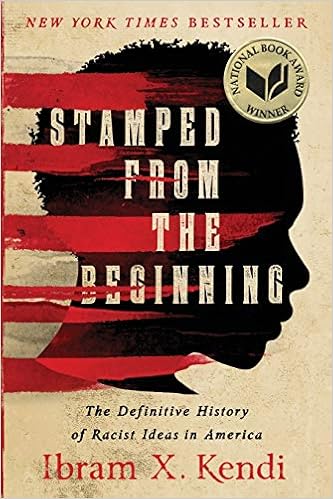
Book Report: Ibram X. Kendi, Stamped from the Beginning: The Definitive History of Racist Ideas in America

 In the New York Times series, "1619," Matthew Desmond makes it clear just how important slavery was to the United States economy.  "[A]t the height of slavery," Desmond says, "the combined value of enslaved workers exceeded that of all the railroads and all the factories in the nation." (Episode 2:  The Economy that Slavery Built, 1619, The New York Times, August 30, 2019,  https://www.nytimes.com/2019/08/30/podcasts/1619-slavery-cotton-capitalism.html?showTranscript=1) Slavery moved the United States economy from a fledgling nation to a money-making powerhouse.  

Our country's prosperity was built on a brutal economy that was too big to fail.  When cotton farmers experienced a crippling economic downturn, banks were right there to loan them money and prop up the system of slavery.  This is the point Dr. Kendi makes in his incredible book.  Slavery and racism were intentional choices made to increase profits and promote a whole system that constructed and maintained "race."  In turn, United States policy and practice made Black people non human beings.  Taught, codified, mythologized, and even celebrated, some huge African-American pillars of Black history "housed" this oppression and death by suggesting that African culture and Black people  were "less than" and would need to evolve before their total freedom could be given.

My family knows me to be the most unnerving movie critic to relate how movies are the storytellers and myth makers for our age.  Not so much I guess.  One after another, Kendi shared plainly how movies that became iconic for our nation were a retelling of our racist narrative.  How could I not see "King Kong" or "Planet of the Apes" as part of that narrative?  Under Kendi's pen, I saw it clearly.

Kendi states that racism was borne out of self-interest.  It must come to an end out of self-interest.  I know that reality all too well.  My racism with the Native community was transformed and continues to be transformed as I realized the goodness that flowed to me as Native people, with all of their vices and virtues, moved on me.  That so many Native people consider me a friend when I know the history . . . I break into tears.  I cannot comprehend that.  My personal racism is broken recognizing how bringing an end to it benefits me as a whole.  I wish I could say I was more courageous.  

This text is so daunting that it took me several days to even contemplate writing this book report.  Kendi is relentless in maintaining focus so that we cannot avert our eyes from our country's long history of maintaining Black people as non humans.  I certainly knew of the critique of one of my heroes, Abraham Lincoln.  Kendi makes it clear that Lincoln certainly did not see Black people as equals.  

He also, however, takes on Dr. Martin Luther King, Jr.   Kendi devoted a whole section to W. E. B. Du Bois, recognizing that as one of the wisdom-givers of Black people in the United States, he really was not an anti-racist until much later in his life.   I found myself blinking at the critical eye he leveled at Du Bois.  At the same time, that unflinching criticism (for good or ill) gave Kendi's prose an integrity that was in keeping with one of his main categories.

He was not telling us the story of "the extraordinary Negro."  He did not want us to think that racism will disappear if we just show any number of African American people who were beyond reproach.  The primary drive of anti-racism is to give African-American people a space where they might be known as full human beings--capable of great virtue and great vice.  He also related the intersectionality of gender and its interplay with racism.  He praised Ida B. Wells as an anti-racist who did not get the platform she deserved.  He also lifted up Zora Neale Hurston and my favorite novel, Their Eyes Were Watching God.  Kendi praised the book because it showed Black people as human beings--making mistakes, seeing beauty, and, I would say, finding love, sensuality, and heartache along the way.  

Though his categories may not be original to him, he has now lifted those categories in a way that will make them primary in the lexicon of racial discourse.  My only negative critique of the text was that although things like "moral suasion" have not created and will not create the necessary transformation around race, I believe we need to bring everything to the table to create the transformation.  I do think moral suasion has had some effect.  

Kendi is right though.  Race is defined by power.  So we will need, as he asserts, anti-racist people in power over a long period of time to create ongoing policy and practice that are anti-racist.  We have too long had virtue signaling toward race while keeping policy and practice in place.  Or leaders who seek to reach "middle ground" when one of the positions is that Black people are human beings.  There is no other side.  Black people are human beings.  Black lives matter.  

Kendi wants us to end racial discrimination in policy and practice.  We have the power to make that transformation.  Much like Abraham Lincoln ended slavery to save the Union, Kendi writes, we must now end racism out of our own self-interest.  I pray we are ready.  

I have just finished three different texts that discuss what it means to be a human being.  We need an incredible intersectional movement that seats people in power and demands of people in power that there is no compromise on that definition.  Jacob Blake's father kept repeating to us, "He's a human being!  He's a human being!"  He knows what so much State violence against the Black community means.  That it happens and we either ignore or sanction that violence means we do not understand Black people as human beings.  

Faith communities must make that a singular focus as they make meaning, critique power, and seek to do justice.  We must come to grips with that necessarily political endeavor.  And then rights must be extended to creation--animals, rivers, land--as subjects (acting on us) who are in relationship with us.  The Supreme Court made corporations human beings.   All they were doing was ratifying policies and practices we have long held in this country over and against peoples and planet.

Some of you know how angry I was at RBG for not affording asylum seekers equal protection under the law (in other words, they are not human beings).

Kendi keeps us focused in a text that is over 500 pages.  That is the power of this book.  My greatest prayer is that white folk will use this text to hold their own focus and work toward Kendi's counsel.

There are more poetic and certainly will be better histories told of race in our country.  Kendi's plain prose, however, has cultivated categories that will be the standards for time forward.  He has a lens that doesn't try to be groundbreaking so much as straightforward, truth-telling, and insistent.  As I read, I could almost recognize the voice of Dr. Kendi behind me, saying, "See?  Is it plain to you now?  This is inescapable."


Tuesday, March 14, 2017

Sermon for the Second Sunday of Lent, March 12, 2017, "Every path is blessed"

A Lent 2 BFC 2017
Genesis 12:1-4a; John 3:1-17
March 12, 2017

          One of my favorite novels is from 1937, Zora Neale Hurston’s, Their Eyes Were Watching God.  Hurston tells the tale of Janie Crawford, who takes this circuitous path to finding blessing and joy.  The poetic and sensually detailed ways that Hurston describes this through Janie’s eyes are what captivates me.  Janie had a hard life, a difficult life, filled with hurricane and hardship, the bitter sting of rivalry and racism.  Yet, she still knew her path to be blessed.  That was beautifully described at the end of the novel.  Before Janie even begins her journey, Hurston describes Janie’s kind heart, the way the universe blesses her difficult path:

[Janie] often spoke to falling seeds and said, “Ah hope you fall on soft ground,” because she had heard seeds saying that to each other as they passed.  She knew the world was a stallion rolling in the blue pasture of ether.  She knew that God tore down the old world every evening and built a new one by sun-up.  It was wonderful to see it take form with the sun and emerge from the gray dust of its making.  The familiar people and things had failed her so she hung over the gate and looked up the road towards way off.[1]

The way Hurston describes Janie in this short paragraph, before she heads out on her life’s journey, we are made aware that whatever the journey, Janie would walk the path with an expectation of goodness and an intention for kindness.  I hope you fall on soft ground.  She had heard seeds say that to one another.
While I was the youth pastor at Community United Church of Christ in Morton, Illinois, my family was living in Sheffield, a small town outside the small town of Princeton, Illinois.  On the days I went into work, I would travel the hour and a half down Route 40 past corn fields and soybean fields, past abandoned farm houses and Tanner’s Orchard.  Ok, so sometimes I would stop at Tanner’s Orchard and get the best apple fritters known to humankind, the best days when they were right out of the oven into my hands. 
          Morton, Illinois, was twenty minutes away from my home church in Metamora, Illinois, so all this traveling reminded me how much the geography had become a part of my being.  Metamora is home, where I could play out in the yard on a fall evening and hear my dad over the public address system as he worked with the high school band to get the halftime show right before football games, play wiffle ball games with my brother all summer long, or have hot dogs and baked beans with my family on Sundays just after Mutual of Omaha’s Wild Kingdom moved into the Wonderful World of Disney.  All of these memories and experiences rhythmically tied into me this idyllic, rural white family life—most of it true, some of it not sharing the whole truth.
So it was especially hard when my adult family decided to leave those landscapes and make the move to Wichita, Kansas.  I would literally bawl as I drove past those corn and soybean fields, those abandoned farm houses and, ok, I would still stop at Tanner’s Orchard.  I was leaving home for Wichita, Kansas.  What I could not imagine until I was in Wichita, far from all that was familiar, was that there were two United Church of Christ churches which would bear me and my boys up as my marriage continued to disintegrate.  Never would I believe that God had called me to Wichita.  And yet . . .certainly, God blessed me on that path.
          When Tracy and I were working together in New Hampshire, people would point to the direction of the church and say, “Is it clear to you now that God called you to this church?”  We appreciated what we thought was a nice compliment in that question, implying that things were going well enough to believe that God had somehow blessed our ministry and the relationship we had with the church.  After all, the Junior and Senior High Youth groups were going well, the Sunday School seemed to be running full steam, and women’s book club was going strong.   . . . Ok, God had blessed Tracy’s ministry in North Hampton and I was just learning at her feet.
          Seriously though, I’m not really sure I believe God gets involved in that kind of micromanagement, choosing a specific road we shall walk.  I believe, rather, God shows us how to walk the road, whatever that given road is to be.  And too often it is the case that as Christians we want to know that we are on the right road when, actually, there are any number of roads we can take.  We have defined faith as a particular road, trusting God to lead us down the right road.  Perhaps faith is knowing that all roads are blessed as long as we walk the road with character.  Faith is trusting the way God has given us to walk will meet with God’s presence.
          We just need to get on the journey so that it can be blessed.  We are a pilgrim people.  That is the story of our ancestors.
          Abram and Sarai take up the journey started by Abram’s father, Terah, to leave their ancestral home, located in what is now southern Iraq, to travel through Iran and Syria, to they know not where.  Unfortunately, the travel ban would make sure that our spiritual ancestors would never make it to our part of the world.  Abram and Sarai do not know the place, but they learn how they are to walk the road.  Almost all of our spiritual ancestors were immigrants and refugees, nomads depending on the hospitality of others, showing their character and kindness by then extending hospitality and kindness to others. 
          In the Gospel text, Nicodemus comes to Jesus at night, perhaps hedging his bets and wanting to assent to the truth he hears in Jesus without doing any traveling himself.  Nicodemus wants to nod his head without making any life-transforming decisions.  Nicodemus says to Jesus, “Hey, I’m old, you can’t expect me to give birth at this age?”  Jesus does not validate the reasons why Nicodemus cannot travel.  The birth needs to happen.   The blessed path and transformation beckon.  Set out from the familiar place and begin.  It is not where you go, it is who you are as you go.
          All institutions, but particularly the Christian church has a bad habit of ignoring stories like these to take one experience of God, building an altar in that place, and then fully expecting that without moving—God will forever appear at that one place in the road.  We know God calls us to be a pilgrim people, but we so want to believe that God will appear in that same exact spot in the same exact way again.  If we just stay in this place, where we saw and talked and had an experience of God the last time, we believe God will show up again.  Oh, and it will happen, we convince ourselves.  We’re just not praying hard enough or singing loud enough or something enough like we did back then to get God back. 
          And very often God is far down the road, looking back, wondering why we’ve stopped, hoping we will follow.  We sound just as shocked as Nicodemus that God wants to talk about new birth, a new road to travel with unfamiliar landmarks.  “Hey, God, we’re here, remember us, remember last time.”
          Billings First Congregational Church has a glorious past.  It has been served well and I’m sure many of you, who have been members here for an untold amount of years, can share idyllic stories that are mostly true, some of them maybe not sharing the whole truth.  And for some reason, inexplicably, almost three years ago now, this congregation called me to ordained ministry in Billings, Montana—one of the former VISTA volunteers, not really feeling the love at the time, referred to Billings as Mississippi but with cold and snow.  I was leaving a congregation that I loved but that would refuse to get its financial house in order and coming to a congregation that had a 2 million dollar endowment, planning for its financial future—which was mostly true. 
          Let me tell you what I saw when I arrived.  I saw a church, strongly aware of its past identity, struggling to find its own identity in something that was present and future, some of that wondering whether that was found in downtown.  I saw a downtown, being dragged by great leadership, kicking and screaming into a renaissance of re-naming and inclusivity, responsibility and diverse understandings of beauty.  I saw great female leaders, throughout our congregation and in downtown, emerging as the real workers in healing, coalition, and community building.  I saw Native American people tired of the everyday racism that had gotten into the bones of their families and communities deciding that something was stirring and emerging which would bring health and life and recovery not only to the Native American community but to all of Billings.  I saw an influx of young adults into Billings through programs like Americorps VISTA, Jesuit Volunteers, and United Methodist ministries and personally witness the power, idealism, and energy these young adults bring to our community.  Many of those young adults have heard God’s call to care for our planet and Northern Plains picked up on that, smartly hired many of them, and continues to be a place of leadership around building alliances with conservatives, progressives, Native American communities and nations, and celebrates that regularly with good food and music. 
          All of that is what I see, energy and life and courage, bubbling at the surface, calling some faith community, any faith community, to the road, a blessed path where God, or whatever you want to call God, is waiting to unleash that energy, life, and courage on some people who believe that walking the hard road together is worth it.  I see God praying with full and hopeful heart that there might be a “house for all peoples” in Billings--a people who learn to form alliances with those seeking inclusion and justice; a people who follow Jesus in challenging all social boundaries that seek to exclude to embrace the reality of pluralism so we can become an advocate of multiculturalism; a people and home who reclaim and imagine a collective experience and common place that rediscovers a love for the land, gives voice to the possibility of local economic self-determination; a people who are about community and collective practice that lives within the context of our geographical landscape.[2]  We do not know what road or path we are called to walk, but we do know we are called to walk it with a certain character.
          By contrast, Ken Sehested[3] retells a story from philosopher and Christian theologian, Søren Kierkegaard.  The story is about a flock of geese sequestered in a barnyard.  Every seventh day these geese stood in neat and solemn rows and their most eloquent orator got up on the fence and told them of the wonders of geese.  He described the courage of their ancestors who had dared to mount up on wings and fly great distances.  He spoke of the Creator who had given geese strong and able wings that allowed them to soar and swoop.
          The words never failed to inspire the assembled flock, filling them with awe and wonder.  Time and again, they would nod their heads in conviction.  One thing, however, they did not do—they did not fly.  For the corn was good and the barnyard was secure.
          Sehested goes on to say that like these geese in Kierkegaard’s story, we rarely respond to the tales of our faith-filled spiritual ancestors with more than a nodding of our heads.  We say, “Amen,” we feel a wonderful warming in our hearts, but we do not fly.[4]
          When the corn is good and the barnyard is secure, we forget that we are a pilgrim people.  We forget that the stories of Abram and Sarai, Jesus and Nicodemus tell us that God is very often calling us from those familiar, safe places to walk the road, to a new birth, to fly.
          Unlike those comfortable fowl on the farm, my hope is that people in this congregation are being encouraged to fly—for the corn here is good and the barnyard secure.  Our faith stories tell us that no matter what our age or the time of day, we are being asked to set out expecting new births, transformations, and the presence of God to go ahead of us.  Let us respond to those faith-filled spiritual ancestors by flying as they did. 
As Janie did.  At the end of Their Eyes Were Watching God, Hurston writes that beautiful, sensual prose,

The kiss of his memory made pictures of love and light against the wall. Here was peace. [Janie] pulled in her horizon like a great fish-net. Pulled it from around the waist of the world and draped it over her shoulder. So much of life in its meshes! She called in her soul to come and see.[5]

The road, the blessed path, the horizon beckons.  God calls.  What do our souls see?  Amen.


[1] Zora Neal Hurston, Their Eyes Were Watching God, (Philadelphia:  J.B. Lippincott Company, 1937), p. 32
[2] Ched Myers, Who Will Roll Away the Stone?:  Discipleship Queries for First World Christians  (New York:  Orbis Books, 1994), p. 273.  Myers uses the words “anarchicism and bio-regionalism” to define practice.  I have great love for those words but do not believe they can be heard rightly in a North American context.  So I have made them about community and collective practice.
[3] Sehested was formerly executive director of the Alliance of Baptists and co-pastor of the Circle of Mercy in Asheville, North Carolina.  He is now the editor/author of the online journal, prayer&politiks.
[4] Ken Sehested, “Trust and Obey:  Notes toward a spirituality of justice,” The Other Side, March and April 2002.
[5] Hurston, Their Eyes, p. 286.

Sermon, Year A, Second Sunday of Advent, "We need a story that saves us"

A Advent 2 ColPaul AL 2025 Matthew 1:1-17 December 7, 2025           I wanted to offer a trigger warning this morning knowing that we...