Earth Day

Showing posts with label Roman Empire. Show all posts

Friday, August 28, 2020

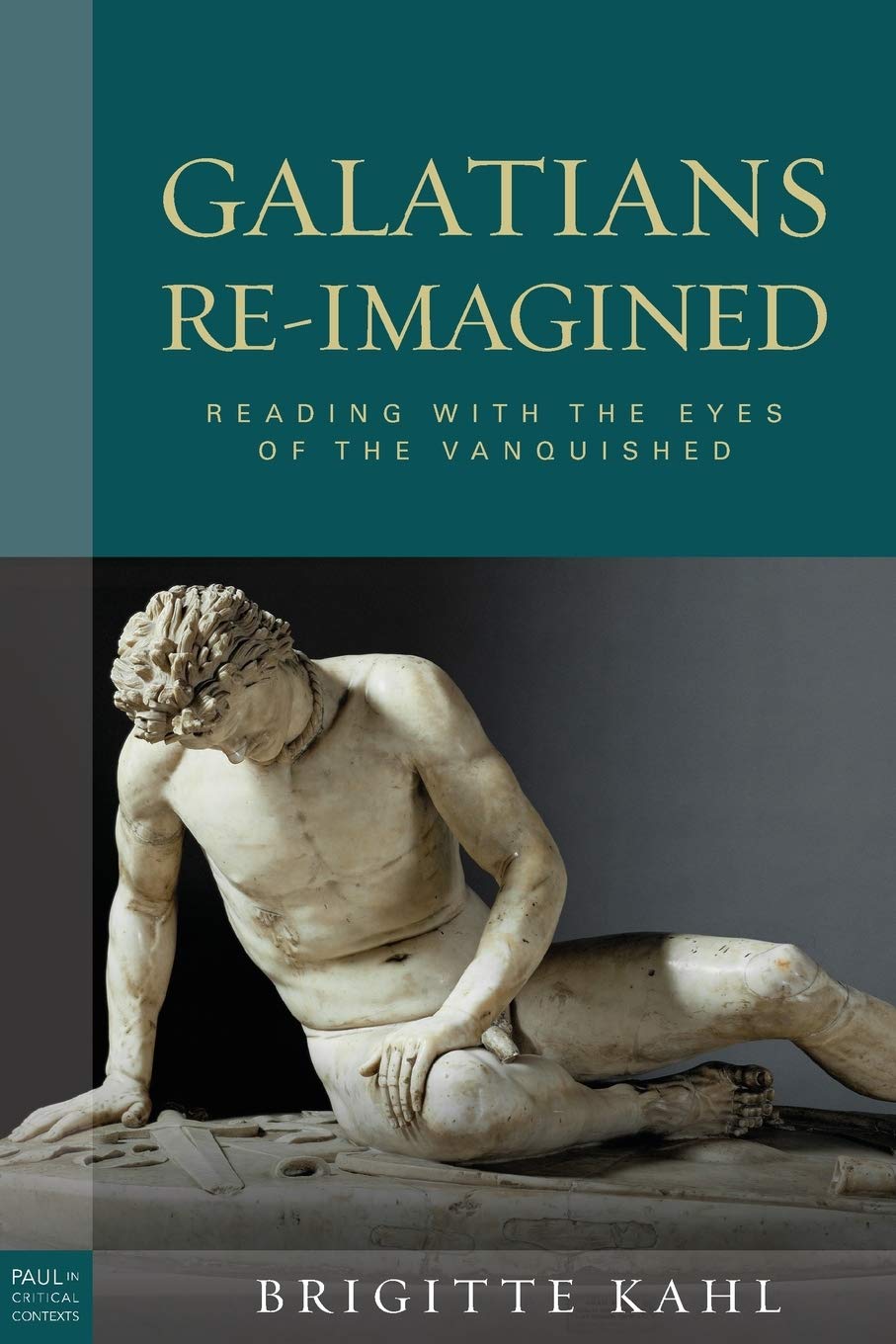
Book Report: Brigitte Kahl, Galatians Re-Imagined: Reading with the Eyes of the Vanquished

 Amazon.com: Galatians Re-Imagined (Paul in Critical Contexts)  (9781451488074): Kahl, Brigitte: BooksIn my time away from serving a local church, I have been catching up on reading and writing alternative worship services.  I usually read several books at one time because I found that I get bored easily and this was a compensation skill I learned early in my life.  If I get bored with one, I can turn to another.  And vice-versa.  So then I end up taking much longer but moving to completion on several books at one time.  For good or for ill, I then end up making connections and reading every book intertextually.  Speaking of intertextually . . .

I read Brigitte Kahl's book, Galatians Re-Imagined, in a cursory way some time ago to get myself ready to preach Galatians.  So I had her conclusions but did not have the incredible back story she provides for seeing Galatians with new eyes and therefore reinterpreting Paul as strongly anti-imperial and his teaching as grounded in his Judaism and within the context of the Roman Empire.  This book has profoundly moved me around the teaching of Paul.  I say that even after having read Richard Horsley and John Dominic Crossan on Paul.  Scholarship was moving this way.

I now have decided to teach New Testament by beginning with the first verse of the Gospel of Mark and then moving to Paul's letter to the Galatians.  This letter, with its radical baptismal formula, helps set the tone for reading of the gospels.  

'What scholars have to do, not unlike an attorney pouring over case law in a particular tradition, is sometimes do their best to ignore the long tradition in favor of a plain reading of the text in its matrix.  Paul was a Jew.  So believing that Paul is going to dismiss Jewish Law is really a stretch.  Paul also lived in the matrix of the Roman Empire, a slave society.  So when he goes on and on about freedom and slavery this is not him providing metaphors for a transcendent, spiritual life.  No.  On the contrary, Paul is citing what people know living under the boot of the Roman Empire.  We are slaves.  Life is hard.  The Roman Empire is doing its best to remind you that you are somehow less than human.  You are "other."

Kahl does a unique thing in this book.  She reads the book of Galatians with an eye toward The Great Altar at Pergamon.  The Attalid Empire constructed The Great Altar as a conveyor of culture, a statement about who was in and who was out, who was "human" and who was "perverse beast."  The Great Altar was later appropriated by the Romans to continue the tradition of using incredible artistic scale to communicate life as the Romans saw it.  

Rome and its gods were victorious bringing peace and justice over the barbarians, the outsiders, "the others."  Those "others," spanning over empires in the ancient world, were the Gauls or the Galatians, Kahl showing how Gauls and Galatians were used interchangeably as this "other" enemy to Rome and its gods.  Chiseled in to  The Great Altar at Pergamon are muscular Gauls/Galatians with nappy hair and serpent's tails.  The Roman gods come from above to bring about law and order amidst the intended chaos waged by the Gauls/Galatians.  

In one frieze, Athena is separating Gaia (coming up from the ground) from her son, Alkyoneus.  In effect, Athena is taking a son from his life source.  Nike also arrives from above to beat back the Gauls/Galatians.  These are strong cultural statements about how unseen, divine forces give validity and justification to who rules the world, who is human and who is not, and who is justified using violence to hold back the chaos.  

Kahl wants us to interpret a frieze like this as we interpret the book of Galatians.  She makes a strong case for Paul not being critical of Jewish Law or Torah but of Roman law.  Jewish Law was and is a way, a path, a vibrant interpretation of God's will and want for the material freedom of God's people and that Law was particularly robust around being a vanguard for the most vulnerable.  Roman law reminds people far and wide of their slave status (The Great Altar shows that the gods affirm that status quo.), who is in charge, and who is human.  

As we read Galatians then, we are reminded that Paul sends this letter to a people who have been historically "othered" by empires.  Not unlike our own country's racism, this "othering" has been communicated in such a strong cultural way that everybody knows it.  It is the soup in which all of the Roman Empire swims.  Once we read the letter to the Galatians as full of Roman language, we begin to see Paul repetitively flipping (maybe flipping off?) the culture in a resistance text.  Rome assumes the violence it preaches.  Paul seeks to dismantle it.  

We read in Paul's letter the baptismal formula that pre-dates him and is the response to this "othering."  There is neither Jew nor Greek, male nor female, slave nor free . . .  I've preached it several times but can we read just how radically counter-cultural that is even today.  Let me back up with it.  It is the antidote to othering.  There is no ethnic, gender or sexual identity, social position or economic status in your baptism.  Humans don't get othered.  

I have also chosen to read two of Paul's key terms, sarx and pneuma, in a light that makes much more contextual sense.  Unfortunately, they have become so loaded with the Christian tradition's preoccupation with sexuality that they have lost their power.  Sarx is translated as sex when what Paul is saying is alluding to shallow or empty values.  So I choose to translate sarx as is "skin-deep."  Pneuma , translated as Spirit, is about something or values that have deep and enduring meaning.   Paul is trying to locate sarx around our edges and locate pneuma deep in the heart or gut.  

With President Trump sound the alarm for "law and order" amidst meaningful protests and statements from Jacob Blake's family, how powerful is this text that tells us, once again, what empire is trying to do.  President Trump is signalling.  We are the civilized to bring order to chaos.  We are the humans.  You are the barbarian animals.  Therefore, our violence against you is justified.  Any harm, however small, is magnified to show once again that you are the perverted beasts.  

We watch that video of Jacob Blake and we know better.   See what some have tried to do to Jacob Blake?  They bring up a knife, recite crimes he may have done, all to suggest that he is "other", a barbarian that the State is justified in doing any kind of violence it chooses to him.  

Paul, in Galatians, recognizes that "law and order" as counter to the will of God.  Jacob's father repeated it over and over again in his first press conference.  "He is a human being.  He is a human being."  For a good portion of our country, that truth has yet to become real in their lives.  The Great Altar of Pergamon, reciting Roman victory over its enemies through violence,  is still a text read well by the people of our own country.  Roman military victories were pronounced as good news, as gospel by the ruling class.  We need another gospel.

Wednesday, January 9, 2019

Epiphany Day, January 6, 2019, "The Gospels As Science Fiction"


C Epiphany Day BFC 2019
Matthew 2:1-12
January 6, 2019

From African-American science fiction writer, Octavia Butler, “all
that you touch, you change. all that you change, changes you.”  Let us pray.  May the imperfect words of my mouth and the meditations of our hearts be acceptable in your sight, O God, our Rock and our Redeemer.  Amen. 
African-American author and organizer, Adrienne Maree Brown has written:

all organizing is science fiction.
we are creating a world we have never seen. we are whispering it to each other cuddled in the dark, and we are screaming it at people who are so scared of it that they dress themselves in war regalia to turn and face us.[1]
In effect, this is what the gospels are.  They are a form of science fiction mystery which calls us to an imagining with God, an imagining of a different future--without violence and war, without hunger, poverty, and oppression.  It borrows the language and vision, the science fiction of prophets who spoke from the time after the Exile,

The Living God shall judge between many peoples,
    and shall arbitrate between strong nations far away;
they shall beat their swords into plowshares,
    and their spears into pruning hooks;
nation shall not lift up sword against nation,
    neither shall they learn war any more;
but they shall all sit under their own vines and under their own fig trees,
    and no one shall make them afraid;[2]

As Brown writes, “it’s neither utopian nor dystopian, it’s more like life.”[3]  It is the science fiction imagined by those prophets who wrote after the Exile, envisioning a time when people might grow food that they might eat themselves, build homes they might inhabit themselves—when all that they could remember of the Exile was growing food for others to eat, building homes for others to inhabit.[4]  From these writers, the gospel writers borrowed heavily. 
My critique against modern day Gospel interpretations, even more so Christmas stories, is that they are sentimental and vanilla, the Bible a little rule book that misses the vision, humor, and mystery found in its holy pages.  Identities, signs, and symbols are references to the deep memory of the Jewish people so that they might remember who they are and what God calls them to be in a different place. 
The author of the gospel of Matthew frames the identity and titles of Jesus in very clear ways.  One of those titles for Jesus is the second Moses, hoping to use the authority of Moses to evangelize Matthew’s Jewish community so that they too might see authority in Jesus.   Two examples.  Jesus escapes the slaughter of babies in Bethlehem at the hand of the local client king, Herod the Great, as Moses escaped the killing of male children in Egypt at the hand of Pharaoh.  While Jesus gives his famed sermon with the new commandments on the plain in the Gospel of Luke, the Gospel of Matthew has Jesus speak the beatitudes from the mount.   The mount is the place where Moses also shares the new rules for living in the wilderness, The Ten Commandments, way back in Exodus.  According to the author of the Gospel of Matthew, Jesus is the second Moses.
The other title is evident in the first two chapters of Matthew, including the passage we have before us today.  In chapter 1, King David is the axis point in listing the ancestors of the Messiah, the Christ, the Anointed One.  There are fourteen generations from Father Abraham to King David.  There are fourteen generations from King David to the Babylonian Exile.  There are fourteen generations from the Babylonian Exile to the Messiah, a title usually reserved in Jewish mythology for a king, prophet, or liberator.  The poetic style of Jesus’ genealogy says in effect, “As King David, so now the Messiah.”
Within the Scripture passage for today, is prose that is not only meant to antagonize the Romans but, in particular, Herod the Great, King Herod, colloquially known as the King of the Jews, serving at the whim and will of the Roman Empire and its Caesar.  And here come the Magi in their traditional role, as people who pose a threat to ruling powers.[5]  You may have heard it before, but it bears repeating.  We have regularly assumed three magi made the journey because there are three gifts.  But the story does not tell us how many.  Imagine at least 12 magi, in their traditional role, taking a little side trip to Jerusalem just to stick it in and twist it by innocently asking Herod, “Where will we find the King of the Jews?”  In the movie version of this scene, I imagine Herod, who believes King of the Jews is a title reserved only for him, excusing himself and finding a private room where he punches his royal purple walls for about a half hour before he returns.
The question by the Magi is a form of Biblical humor, sarcasm aimed at the upper-crust and powerful.   In our modern world, it might be a number of radical Muslim clerics arriving in Washington, D.C., asking where they might find “the leader of the free world.”  Making it clear that they don’t think it’s the president, they move on to Haiti to follow the star they have seen.  It’s a snub, a diss, to move from the seat of Rome’s political and religious power in Jerusalem to a place on the margins. 
The Magi come from the East, the place of the Roman Empire’s mortal enemy, the Parthian Empire.  Imagine not only 12 magi arriving in Jerusalem but maybe 50 to 100 of them with all of their royal servants and accoutrements.  For the Biblical passage says that when the magi tell Herod of the star they have seen Herod and all of Jerusalem is frightened.  That is the other role played by the Magi.  They were the king makers.  The Magi looked for portents, signs in the natural world, which would tell of the passing of an old order in favor of something new.  
The first-century Jewish historian, Flavius Josephus, tells of a star or comet which was like a sword that appeared as the Romans besieged the city of Jerusalem close to 70 years later.  That star or comet was taken as a sign by the Jews defending Jerusalem that God was fighting on their behalf and gave them hope when Roman legions had them surrounded and outnumbered.[6]  These signs or portents were part of Jewish mythology that hoped for liberation from alien rule.[7]   Biblical scholars date the writing of the Gospel of Matthew five to ten years after the Romans destroyed the city of Jerusalem. 
As the seat of Roman-controlled Jewish power, everyone in Jerusalem knew that a star sighted by the Magi could only mean that change and transformation were about to occur, a new king was on the rise.  Three times in Matthew, Chapter 2, it says that these “king makers” prostrate themselves before the infant child, a form of worship and reverence for a ruler or an emperor.  Not once did these same magi do so for King Herod.[8]  They have made their choice.  The Magi proclaim who is the king of kings.
The gifts of gold, frankincense, and myrrh evoke the words of Psalm 72 where nations and kings shall make a pilgrimage to Zion to lay these gifts at the feet of the king who is full of justice for the economically poor and crushes the oppressor.  Three times in Chapter 2, Herod’s death is mentioned, as a way of suggesting that when God’s narrative and the narrative of imperial power come into conflict, imperial power is not ultimate.  The imperial system, a system exposed as ruthless and murderous, opposes the presence and power of God, and at each turn the imperial system is thwarted in trying to kill the new king.  The Magi are uncooperative.  Angels and dreams further the will of God.  Though the Holy Family must quickly leave for exile in Egypt, the imperial system is not the ultimate.  Rome has its limits.  While Caesar claims the god, Jupiter’s presence, for Rome, throughout the Gospel of Matthew claims are made for Jesus’s presence among the community of the disciples even after the Empire crucifies him and he dies.[9]
The title of king is not taken lightly by the Romans.  Those who claimed the title without ordination by Rome were routinely executed.  Josephus chronicles that others who took the title were Simon, who was beheaded, Athronges who was captured, Menachem was killed, and another Simon, who led one of the longest and most successful revolts against the empire, was executed in Rome’s capital city as a dramatic presentation of Rome’s superiority and intolerance for any challenges to its superiority.[10]
Religion and politics were inseparable in First Century Rome, made even clearer by the Christmas stories that Luke and Matthew put before us.  The Magi were political and religious figures in the Eastern Empire over and against the Western Empire where an indigenous Jewish population longed for liberation and an end to the very real economic, political, and social violence they experienced every day of their lives.  Jesus of Nazareth became a symbol of hope and resistance because of the very real and gritty ways he offered ways of living that helped Galileean communities to be sustainable and resilient at a time when they were fracturing due to the intense stress, pressure, poverty, and violence they experienced interfacing with Rome and its Caesar.
Here is the warning, the temptation we all have in a culture that wants to make Christmas only about a sentimentality that finds the perfect Christmas tree, sings “Silent Night” with candles ablaze, and walks out of the church on Christmas Eve to see larger-than-life snowflakes falling from the sky.  If we only believe in . . . Santa, the magic of Christmas, even in Jesus, all of the pain fades.  Maybe.
But for some in the world, that pain is all too real.  And a sentimental and vanilla Christmas does not rhyme with their family’s tremendous debt, the fear of one more medical bill, people caught struggling with trauma and addiction, and the worry for some that they will be stopped without proper papers.  Or, now in our own country, what happens if Herod or Caesar come for my family and my children?  What am I to do?  The Gospel of Matthew makes it clear that even Jesus’s arrival does not prevent the slaughter of children, poverty and disease, and deep, deep pain in the world.  What Jesus brings is the idea that God wants a decidedly different world and that God is inviting us in to be collaborators on the project. 
Spiritual guide, Matthew Fox, has written, “Sentimentalism is feelings without care for justice.  Nazi concentration camp hierarchy would torture prisoners during the day and return home at night and weep listening to Beethoven.”[11]
“The tamed piety of the conventional church wants an innocent baby who comes gently into our secure lives and keeps everything benign and friendly.  It may be conventional and it may be tame but it is not biblical and it is not Christian.”[12]  I thank the Living God that I pastor an unconventional church filled with wildly unconventional, courageous, creative, and goofy people.  Ok, so maybe the goofy is just about me.  But you get the idea.  Advent was about both hope and hurt; pain and risk, as well as excitement and joy.  All were part of the adventure.
“Both the hope and the risk of Advent get summed up on Epiphany. The word means ‘manifestation,’ or ‘appearance’ or ‘revelatory moment.’ Theologically speaking, epiphanies signal something new, but—at least for a lot of folk—something uncomfortable as well. Biblical convictions always impinge on political realities. The something new breaking out is good news for some and bad news for others.
“Epiphanies are often disruptive. For new learning to occur, old lessons have to be unlearned. For new public policies to take effect, old policies have to be dismantled. A lot of people have invested heavily in those old policies. Herod certainly understood this.
“Is there any epiphany moment for us, right here, [right in this community of faith]? Is there something new thing to be learned; and if so, what old things must be unlearned?”[13]
On this last day of Christmas, Epiphany Day, I want to invite us all over again to be Christ’s church, a symbol of hope and resistance over and against Herods and Caesars in each age.  How might we join with, be good allies with an indigenous population that seeks liberation from the everyday warfare aimed at its people?  What would we look like if we began to put that in place over the next 5 to 10 years?  In this day, the Magi come looking for the people who walk the path of a new king, people who seek to be collaborators on the project God has set before communities of sustainability and resilience.  Billings has never been the center of the universe, but neither were Bethlehem and Nazareth.  People of good courage, let us begin, with imagination and vision to walk the road.  Begin to plan out the mystery of the course of this year, what that yet may be. Like the Magi, what are we willing to walk a long time for?  Let


[1] Adrienne Maree Brown, “afrofuturism and #blackspring (new school, #afroturismtns),” adrienne maree brown, May 2, 2015,
[2] Micah 4:3-4a
[3] Ibid.
[4] Isaiah 65:21.  Reminiscent of the Homegrown Prosperity initiative from Northern Plains, “We are building diverse and resilient local economies that work for all of us.”  That involves three initiatives:  1) Rebuilding local food systems; 2) Reclaiming coal country; 3) Powering up the clean energy economy.  That mission statement and those initiatives sound very much like the post-Exilic verse from Isaiah.
[5] Warren Carter, Matthew and Empire:  Initial Explorations (Harrisburg, PA:  Trinity Press International, 2001), pp. 66-67.
[6] Richard A. Horsley, The Liberation of Christmas:  The Infancy Narratives in Social Context (New York:  The Crossroad Publishing Company, 1989), p. 59.  using Flavius Josephus, War, 6.289.
[7] Horsley, The Liberation, p. 59.
[8] Carter, Matthew and Empire, p. 66.
[9] Ibid, p. 67.
[10] Ibid, p. 161.
[11] Matthew Fox, The Pope’s War:  Why Ratzinger’s Secret Crusade Has Imperiled the Church and How It Can Be Saved  (New York:  Sterling Ethos, 2011), p. 39.
[12] Ken Sehested quoting Kyle Childress, “Wiseguys and one scared king,” Prayer and politiks, January 1, 2012.  http://www.prayerandpolitiks.org/articles-essays-sermons/2019/01/04/wiseguys-and-one-scared-king.3418910.
[13] Ken Sehested, “Wiseguys and one scared king,” Prayer and politiks, January 1, 2012.  http://www.prayerandpolitiks.org/articles-essays-sermons/2019/01/04/wiseguys-and-one-scared-king.3418910. 

Thursday, May 17, 2018

Easter Day, "Resurrection is a this-worldly experience"


B Easter Day BFC 2018
Mark 16:1-8
April 1, 2018

          I think one of the great sins of modern-day Christianity is that it has become an other-worldly religion.  Christianity has become about heaven and hell, judgment and the after-life.  I think the result of this emphasis is that we really don’t need to care about the soil or the atmosphere, even though Biblical faith tells us that we are made out of the deep black and brown of the earth and the wind and breath of the atmosphere.   Instead, we end up with a sky god who seems wholly unconcerned with a relationship to the air, water, and land.  When Biblical faith tells us that the literal translation of the word salvation is “a broad and spacious place for community life and conduct,” we know how central land is to our faith story. The land is the part of the promise, the substance of God’s covenant, the very context for all of our relationships.
          When the Biblical God is made into nothing more than a sky god, then the material bases of life become unimportant.  The imperial narrative tells us to pay attention to the otherworldly battle that is going on to understand why they or we have the authority over life and death, food and land, air and water.  Our gods won.  “So we win,” empire says, “and there is only so much to go around.  Soooooo . . . sorry.” 
Through Pax Romana, Deutschland über alles, and manifest destiny, all of the land that stretches into the horizon is declared the individual property of empire.  We therefore reserve the right to dominate, occupy, colonize, confiscate, and liquidate land first; and bodies second.  The violence of empire becomes like a legion of demons—poisoning the land; spirits--housed in our own bodies.  
We get the message loud and clear.  Empire homogenizes to commodify and divides to conquer.   It tells us that the goodness of God is scarce so you had better get yourself some over and against your neighbor.  First the land and then bodies.  The message is so thick that sometimes we allow the imperial demons to take hold and we experience or do to our own bodies what we hear to be the imperial gospel—dominating, abusing, cutting, starving, drugging, sedating, objectifying—until we can no longer hear God’s voice whisper to us, “No.  Child of God.  Beautiful.  Rich.  Free.  Balance.  Strong.  Kind.”
The resurrection is the disruption to the imperial program.  The tomb is empty.  It’s just empty.  The tomb is empty—a fact that creates great fear for the women because to disturb a tomb, by edict of Caesar, was considered dishonorable, a capital offense punishable by death.[1]  So there is this amazement and this trauma upon trauma, this fear that they could be next.  Is it Rome or God that is ever-present?  In their minds, maybe in the midst of their tremendous grief, even though their friend and teacher tried to convince them otherwise, they just don’t know now.  
Is God or empire ever-present for our soul, heart, mind, and strength?   
There is no great appearance story in the Gospel of Mark--no Mary mistaking him for the gardener; or him walking on the road to Emmaus with disciples; no appearing in the Upper Room to have Thomas put his hands in his side or cooking fish while the disciples cast their nets looking for a haul.  The Scripture passage starts with the Marys headed to the tomb, not even knowing how they will get the stone rolled away.  Rome used crucifixion, like other empires used lynching[2], to not only liquidate the person but to also create so much trauma in the horrific death that they would liquidate his memory as well.  Cut off the head.  Kill the body.  And the memory of Jesus fades.
          But there is some literary wordplay being used in this story.  The word for “tomb” comes from the Greek word for “memory” and the word for “entrance” means “gateway” or “door.”[3]  So as the women wonder who will roll away a stone that is the gateway to memory, the Marys are surprised to find that the stone has already been rolled back.  And so, the door to memory of their beloved teacher and friend has been made possible.  Now they are given permission to re-member Jesus and his whole program, his whole enterprise--over and over again.    
          Notice in this resurrection story that there is no story of Jesus ascending to the sky or some metaphysical experience of Jesus as some other life form.  The person in white who greets the two Marys is not even a divine being.  It is a young man.  And he tells them what the resurrection means.  It means that God affirms the whole project, the whole program.  “Jesus is hoofing it back to the homeland, Galilee” the young man tells them, where Jesus has a connection to the rich black and brown soil, where bread and fish are shared, where demons are thrown out of bodies and off the land, and where the ravages of empire on bodies in sickness and death are healed.   It is not about some otherworldly experience.  Resurrection tells the two Marys that in the gateway to their memories, go and relive the mission and ministry of Jesus back in Galilee—the land that is in every bone and sinew, in every synapse and blood vessel.   Through the resurrection power of God, the mission and ministry in Galilee has a connotation that life is shared, in and out are blurred, and diversity is to be celebrated.  Christ has already started the movement before you—disrupted the imperial occupation and colonization in body to go back to the land and begin the nonviolent confrontation of empire--exorcising demons, creating a mutuality between healing and hospitality, and sharing bread and grape across the table. 
          Activist and professor, Loretta Ross, has said, “When people think many different thoughts and move in the same direction, that’s a movement.  When they think the same thoughts and move in the same direction, that’s a cult.”[4]  From its very beginning, Christianity was intended to be a disruptive movement, the resistance, over and against the violence of empire.  And the early Christian movement was not known for its sameness in belief, ortho-doxy, but for its sameness in practice and direction, ortho-praxis.  As Christianity became an imperial narrative, however, ortho-doxy (right belief) became primary--faith homogenized to lose all of its color, commodified to lose all of its courage. 
          We currently live in a time where we are told that there is scarce justice, scarce attention, and scarce liberation.  We believe we are inevitably pitted against each other such that we worry that what is the worst thing in our lives won’t get the attention it deserves.  “How come your worst thing gets attention and my worst thing didn’t?”  That scarcity is an imperial lie.  In God’s land, in the place the resurrected Christ is going to in Galilee, the common quilt stitched together through the hard work in our diverse lives, there is abundant justice, abundant attention, and abundant liberation.[5]
          Throughout this whole season of Lent, I have asked us to develop attention liberation leading to transformative justice.  I have done that believing we are forever diverted and distracted, seduced to try and win the Game of Thrones that leaves the whole world tattered in chaos and ruin.  We have to stop trying to succeed at the imperial project, pretending we can win it if we just play the right numbers, bet on the right horse, straighten out our lives and look a little more presentable.  Resurrection is not winning.  Resurrection is God saying that even crucified bodies, traumatized peoples, are called to rise up and join themselves to the shared program and plan in Galilee.  God’s empire does not win because God does not play that game. 
The jailbreak has already happened.  We may be scared, terrified, amazed, but, over and over again, Christ is being resurrected to do the work of the gospel.  Come to the empty tomb to enter into re-membrance of who he was in Galilee.  Re-member yourselves, re-member your community, re-member the good earth, people of dark rich soil and holy wind, and then follow.  For, sisters and brothers, siblings and cousins, Christ is risen.  He is risen indeed.  Amen. 


[1] Bruce J. Malina, Social Science Commentary on the Synoptic Gospels (Minneapolis:  Augsburg Fortress, 2003), p. 383.
[2] That would be our empire.  James H. Cone, The Cross and the Lynching Tree (Maryknoll, NY:  Orbis Books, 2011).  Contrary to popular belief, lynching was a popular white social activity. 
[3] James Rowe, “Mark 16:1-8,” Lectionary Greek, April 3, 2012, http://lectionarygreek.blogspot.com/2012/04/mark-161-8.html.
[4] Rachell Ravelli, “‘Call In, Call Out’ talk examines current human rights movement,” The Massachusetts Daily Collegian, March 10, 2016.  https://dailycollegian.com/2016/03/call-in-call-out-talk-examines-current-human-rights-movement/.
[5] Really paraphrasing one of my oracles, “Interview with Adrienne Maree Brown:  The World Is a Miraculous Mess and It’s Going to Be All Right,” Yes!  March 17, 2018.  http://www.yesmagazine.org/peace-justice/the-world-is-a-miraculous-mess-and-its-going-to-be-alright-20180327.


Thursday, August 10, 2017

Seventeenth Sunday in Ordinary Time, July 30, 2017, "Mustard and leaven--pervasive and persistent"

Proper A12 Ord 17 BFC 2017
Matthew 13:31-33
July 30, 2017


Just take a look at us
Aren't we ridiculous?
It's safe to say we've got no common sense, yeah
Just take a peek at us
The free song, the mini-bus
The geeks you like to throw into the fence, yeah

You know it really hurts someone loving
You know it really hurts, but we'll rise above it
You know it's gonna hurt
Woah ooh ooh oh, we know what we're worth
And you'll get what you deserve
When all the geeks inherit the Earth, yeah

Hey, aren't we absurd?
We're just a bunch a nerds
Is safe to say you're much cooler than them
So, take your punch at us
Go ahead and steal the lunch from us
We'll take the blow and play our part in the end, yeah

You know it really hurts someone loving
You know it really hurts, but you can't stop it
Right where it really hurts
Woah ooh ooh oh, we know what we're worth
And you'll get what you deserve
When all the geeks inherit the Earth, yeah

You toss your sticks and stones
And we'll just lick our wounds
Beware the underdog
Payback is coming soon

Don't blame the Universe when the commas reverse
Just look at yourself

            That’s a song by singer/songwriter Hailey Knox titled, “The Geeks.”  For a moment, it has us imagine the violence some of the people in grade school and high school experienced, the exclusion and the underdog status they lived in, “Just take a peek at us; The geeks you like to throw into the fence.”  But the song also has us imagine a future that is quite different, a future when the geeks inherit the earth.  “Payback is coming soon,” she relates.  We might imagine that with four-year or even Master’s degrees, good-paying jobs, perhaps white-collar jobs, and legal battles over intellectual property.  Knox even uses language from the Beatitudes (“When all the Geeks inherit the earth”) recognizing that the gospels have a parallel reversal.  We learn that God seeks out transformation.  The world is not as God wills it.  Some of us may have been the kingpins in grade school and high school, the popular kids, the head cheerleader, the football star, with the power to wear the letter jacket proudly and push people around.  We were gods then. 
          But maybe, Knox imagines, maybe this is not the end of the story.  Maybe there is more to write. 
And so it is with God.  We learn that the way we see things may not be the way God sees things.  The way we see ourselves, may not be the way God sees us.  God takes what is a teachable moment in our lives, takes all of our expectations, and turns them on their head.  We may see that play out as we move through grade school and high school into adulthood, but is that possible when we are the poor of the earth?  Is that upending of expectations something we even want to contemplate as the lone super power on the planet?  We might like Knox’s song because we can partially or wholly identify with those geeks, says the pastor with the pocket protector, but is our faith such that we want our expectations, our lives, the world upended?  And does our faith actively call us to see that upending of expectations?
          For the parables taught by Jesus were like that.  They took teachable moments and turned those moments on their head.  Expectations for where people stood in the world, how God saw folks, were used to create a suspended moment and then, through parable, Jesus would open a space where expectations might change, how God saw people might transform.
          Parables begin with things that are familiar, invite us in, make us believe we know the ending of the story.  Biblical scholar, John Dominic Crossan, then talks about a dark interval with parables—a place where reality is suspended for a moment while our whole brain, body, and community receives new information.[1]   Parables flip expectations and give us new perspectives.   But parables do so in a way such that our life cannot be the same as it was, for the reversal is usually done in a place where we are highly invested. 
          Each of these parables begins with a familiar image for the people of First Century Rome—empire.  Empire was the way people described the activity of the Romans in Galilee—how they violently and oppressively kept people in tow.  They dominated the landscape.   Rome had wiped out cities in Galilee[2], cities had been built in tribute to Roman Emperors in Galilee[3], and taxes were all about a trickle-up enterprise that overstuffed the wealthy and leveraged debt to destroy the life of the poor.  People knew the activity of Rome’s Empire.  Jesus was quite clearly invoking the term “empire” for its familiarity and coupling it with a term that immediately opened up a space for seeing empire differently—God.  Or in Matthew’s gospel, Heaven.[4]  Jesus used the Empire of Heaven to ask how heaven might do things differently than Caesar.  How would Heaven’s activity, Heaven’s Empire be any different in perspective?
In the particular Scripture passage from Matthew today, Jesus changes expectations, opens space through parable.  The Empire of Heaven is like a mustard seed or leaven.  As I shared last week, we have often heard these two elements as just how something small can take over and change the very essence of the host where it is planted.  The mustard seed planted becomes a bush that grows wild and takes over the garden, the field, or the land.  The leaven inserted causes the bread to rise and expand.  What we have not often heard is that these two elements, mustard seed and leaven, are considered unclean and make the field and bread unclean.  The Empire of Heaven is like something unclean which planted or inserted takes over and changes the very nature of things.  All of the field, all of the flour has certainly been transformed.
          So why would Jesus use images like a mustard shrub and leaven to talk about the Empire of Heaven?  The image of power and strength and protection within Mediterranean mythology was the cedar of Lebanon, according to the prophet Ezekiel, “with fair branches and forest shade, and of great height, its top among the clouds.  The waters nourished it, the deep made it grow tall, making its rivers flow around the place it was planted, sending forth its streams to all the trees of the field. So it towered high above all the trees of the field; its boughs grew large and its branches long, from abundant water in its shoots.  All the birds of the air made their nests in its boughs; under its branches all the animals of the field gave birth to their young; and in its shade all great nations lived.”[5]  Would this not be the image of power and strength and protection that would most closely rival the Empire of Heaven?  Is the character of Heaven, the activity of Heaven, like a weed that grows into a shrub or a tall and proud tree?
          Or is the character of Heaven, the activity of Heaven, like a woman who hides leaven in the loaf?  One of the things that is apparent from this parable is that Jesus was a brilliant storyteller.  For in one short sentence, Jesus provides a multitude of everyday images that would have created a dark interval by using familiar, everyday images and coupling them in strange and odd ways.  Jesus is not only creating dark intervals.  He is probably blowing the minds of people who hear him.
It begins with equating the character and activity of Heaven to a woman who is working in her household.  Women were the unclean, the religiously impure in Mediterranean societies.  Men were considered the pure.[6]  The Empire of Heaven is equated to a familiar, everyday thing that women do in the household. 
Leaven, in the ancient world, was a symbol for moral corruption.  How leaven came into being in the ancient world supports the idea that it was a corrupting influence.  Bernard Brandon Scott writes, “Leaven is made by taking a piece of bread and storing it in a damp, dark place until mold forms. The bread rots and decays, unlike modern yeast, which is domesticated.”  Leavened bread then invited images of the everyday unholy, rotten,  and profane.  Unleavened bread, on the other hand, invited images of the sacred and holy feast—particularly Passover.[7]
Finally, this woman is not kneading the leaven into the dough.  She is hiding it—using the Greek word (krypto).  This hiding has a more negative connotation than using the Greek word kneading (phyrao), or covering (kalypto).[8]  The hiding suggests that maybe the unclean leaven’s activity is Heaven’s activity.  One would have to be involved in the character and activity to even know what is happening. 
Three images brought together, a woman, leaven, and hiding.  All of those images conveying something about the activity and character of Heaven that would have been considered an insult if used for the activity and character of the Roman Empire.  But in the hands of Jesus, they become about re-imagining a world that invites us to see God as a Bakerwoman who is secretly, hiddenly, changing the whole character and substance of society.
          In societies like first century Rome, two tiers of people existed.  In the top tier were people like rulers, the ruling class, and some merchants.  The bottom of the second tier was occupied by people who were considered the unclean and the expendable.[9]  The disciples of Jesus were among those considered unclean and expendable.  First century Roman philosopher Cicero wrote:  “And the most shameful occupations are those which cater to our sensual pleasures:  ‘fish-sellers, butchers, cooks, poultry-raisers, and fisher[folk],’ . . . .”[10]
          So what would it mean among the unclean and expendable people who followed Jesus, farmers and fisherfolk, prostitutes and tax collectors, to hear that the Empire of Heaven is not like the powerful and proud cedar of Lebanon but like the mustard shrub or leavened bread?  Can we imagine the good news that broke forth in that teachable moment when how God sees us gets turned on its head?
          How often do we find ourselves aspiring for the powerful and proud cedar of Lebanon when actually, truly the God of Jesus meets us and makes a home in the places where we are unclean and broken, expendable and outcast?  We so often struggle to make our faith about what is respectable and what is moral when God, all along, has been trying to share with us a different perspective, a different way of seeing the world, a different way of seeing ourselves.
          God sees us with different eyes.  God sees us with different eyes.  In the places where you are wounded and harmed, bleeding and outcast, God wants you to know that you are precious, and cherished, and loved.  Because, because if you know you are golden to God in those places, the good news will be that this love and compassion intended for you cannot be contained.  This love and compassion will well up to overflowing and where there is wound and harm in the world, the bleeding and the outcast, we will be there to tend and heal.
          You are a weed sown in a field.  You are leaven mixed into bread.  It is not so much that God wants power from you, but wildness and freedom, to not be caught up in the culture and the schemes of the world.   God asks us not to be dominated or over one another, but pervasive and persistent in our work together.
          As Hailey Knox’s song might teach us, we need to remember that our perspective may not be God’s perspective.  Go.  In your uncleanness, grow wild and free.  Be pervasive and persistent.  Do not worry that our movement is not talked about in the halls of power or plastered on the tabloids.   The revolution will not be televised.  Or tweeted.  Learn in the ways that the world calls you unclean, that you are precious, cherished, and loved and that you are in keeping with the character and activity of Heaven.  In that teachable moment, turn the world on its head, so that all who are called unclean may hear the good news and begin to transform the suffering of the planet, not into a haven where people with pocket protectors are safe and powerful, but where the poor and oppressed, sick and dying, the outcast and excluded grow and flourish and change the nature of the garden.   May it be so.  And may we be faithful enough to follow and lead.  Amen.


[1] John Dominic Crossan, The Dark Interval:  Towards a Theology of Story (Polebridge Press, 1988).
[2] Sepphoris (near Nazareth) and Emmaus (probably not around at the time of the Biblical story).
[3] Tiberias and Caesarea Maritima
[4] Although not afraid to use “God” throughout his gospel, the author of Matthew to refer to the Empire or Kingdom.  Scholars have long surmised that this is because the author of Matthew honored Jewish tradition and did not want to insult the author of Matthew’s audience.  But why use the name of God elsewhere?
[5] Ezekiel 31:3b-7
[6] Bernard Brandon Scott, Hear Then the Parable (Minneapolis:  Fortress Press, 1989), p. 326.
[7]Ibid, p. 325.
[8] Ibid, p. 326.
[9] William R. Herzog II, Parables as Subversive Speech:  Jesus as Pedagogue of the Oppressed (Westminster John Knox Press, 1994), pp. 58-59. 
[10] Cicero, On Duties 1.42.

Sermon, Year A, Second Sunday of Advent, "We need a story that saves us"

A Advent 2 ColPaul AL 2025 Matthew 1:1-17 December 7, 2025           I wanted to offer a trigger warning this morning knowing that we...