C Epiphany 3 Pilg 2022
1 Corinthains 12:12-31a
January 23, 2022
About
twenty years ago, I went to hear the message of a Viet Nam War veteran, Brian
Wilson. Wilson related that he had been
one of those pilots who was directly involved with napalm drops over Viet
Nam. He had left law school at
twenty-seven to go fight “communism.”
During his time in Viet Nam, an unusual event happened to transform him
into a peace activist.
Unusual
because during his time in Viet Nam he related that the military had a policy
which did not allow people who performed napalm drops to ever act as later ground
reconnaissance. The policy did not want
those performing napalm drops to connect their acts with suffering experienced
by civilians on the ground.
This one unusual time,
however, there was a snafu. For some
reason, after dropping his napalm on a village, he was also asked to be part of
the ground reconnaissance team to determine the success of their drop. While performing that reconnaissance, he came
upon a dead mother holding her three dead children. Wilson believed the mother’s eyes were still
opened, but as he drew closer, he realized the napalm had melted off her
eyelids.
For some unknown reason,
tears welled up in Brian Wilson’s eyes, and with his commanding officer
present, he fell to his knees and shouted in agony, “This is my mother. And this, these are my children.” Though his commanding officer laughed, he
remembers that as the transformative moment in his life. So transformative, in fact, that he had
become a peace activist.
As a peace activist back
in the States in 1987, he had lost both his legs sitting on a train track
outside of a military weapons facility, hoping to stop weapons bound for
Central America. While sitting on the track, he thought surely the train would
stop and that the armaments would not go through. Other activists had employed this form of
protest successfully. Certainly, Brian
Wilson thought, the train would not go through.
What he could not know is that the train’s conductor had strict orders
to plow through regardless. Or . . . that
the conductor could not see the many people on the track. Both stories are told. What is known is that Wilson was the only one
not able to get up from the track before the train came through.
There Wilson was, on the day I say him, using two prosthetic legs to get around in the world. Putting his legs on the track was a risk he took when the connection to all of life had become vividly apparent to him. He remembered knowing that truth as a young child. But somehow . . . somehow that truth had been drummed out of him by the destructive powers of disconnection and death. Down deep we know this truth, he believed. We are connected..
I have seen that
transformative moment take place on any number of mission delegations when
those going to do the work to bring about salvation realize that they
are the ones being saved. We recognize
that God is doing work we would not have realized beyond Sawyer, or beyond Michigan,
beyond our country. And all of a sudden,
we are overcome with a love we would have never known. It may be spoken in a different language, by
people of a different color, or just in a way we never contemplated
before. And the activity of God, which
looks nothing like we ever expected, loves and connects us in such an amazing
way.
In Paul’s letter to the
churches in Corinth, Paul tries to reach out to communities immersed in conflict. One group or person is vaunting themselves up
over another group or person because of their spiritual gifts. This group believes that God can only be found
within them, in the gift they have been given, or that their understandings and
gifts trump everyone else’s understandings and gifts. Paul turns to them to say, “Don’t you see how
much you need each other? How God in Christ is found in different
manifestations across your community? For you to claim that you are not
connected, that you do not need each other, is to deny the reality.”
We were created as the
Body of Christ, and when we deny others access to the goodness of God through
our unwillingness to see Christ in each other’s eyes, we lose so many gifts God
intends for each of us.
Paul asks, "How can one part of the Body of Christ say it doesn't belong or one part deny another part of the Body?" In this masterpiece of Christian prose, Paul seems to get the eternal conflict of religious life. How we affirm our God-given diversity and our heard work toward unity all at the same time. Too often we deny the way God has made the world for our salvation. We deny our connectedness to each other. We deny that we are the Body of Christ--a Body, Paul writes, where those who appear to be weaker, or the most humble, are the most indispensable.
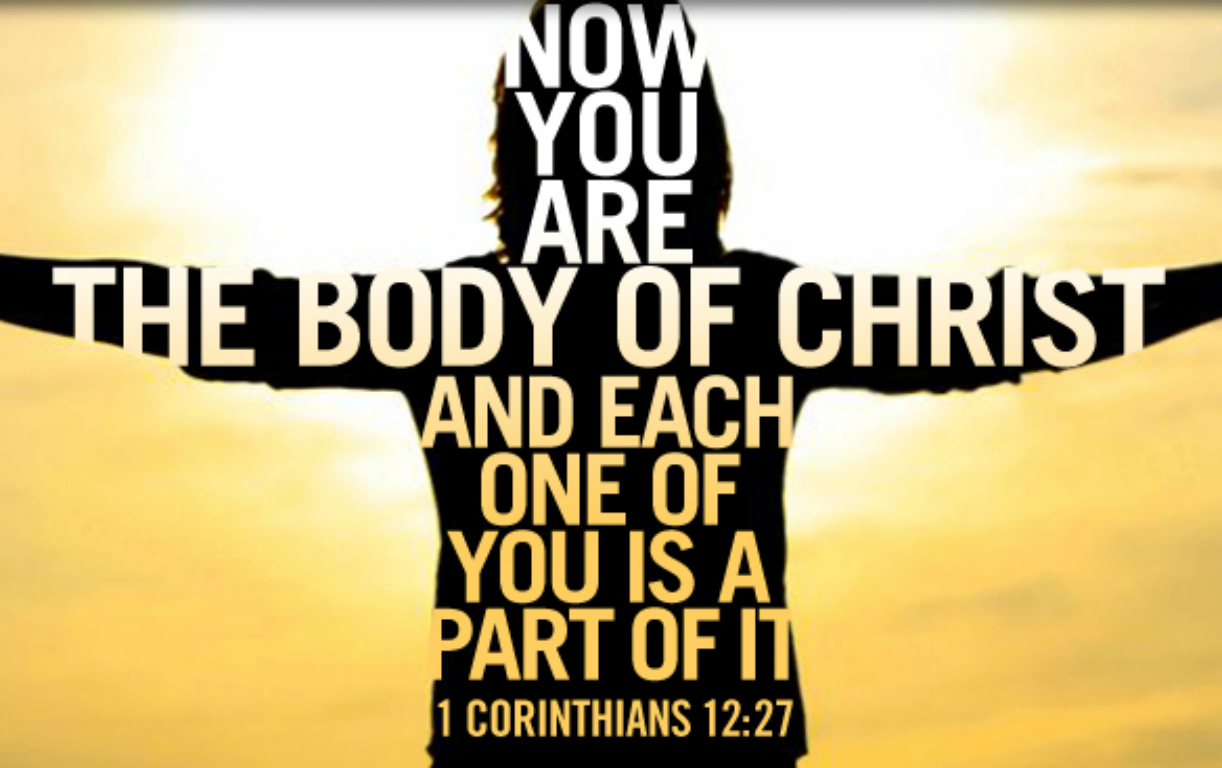
Hear the good news: God wills us to be connected, one to another,
brought together in all of our diversity to form a community which will love
and cherish each other. It is almost as
if God has said, “You know, this is the way I have made the world—with all of
its connection. It will work in no other
way. If you choose to deny the
connections, then the world, as a whole, will suffer because of it. Choose to live in the interconnection and the
building up of community or inherit the destructive powers of disconnection and
death.”
It is not about God’s
judgment but about the consequences of our choices.
The apostle Paul, as a
Jew, would have known this truth through the foundational Jewish value of
hospitality. Jews know that it may very
well be the stranger who teaches them something of God. Of all people, it is the stranger who reminds
us we are connected.
Rabbi Charlie
Cytron-Walker, from the congregation Beth Israel in Colleyville, Texas, is now
known as the courageous leader who threw a chair to help the remaining hostages
and himself escape. He said in an
interview with NPR this past week that the whole incident began with a knock at
the synagogue door. The man was cold so
Rabbi Cytron-Walker made him some tea.
He went on to talk about the reality too many people know in synagogues
and schools.
There have been too many
situations at synagogues, too much violence in our schools, too much violence
overall within our society. And it's horrible. It's not sustainable. It's
something that we collectively need to be able to address. And at the same
time, we have to deal with the practical reality.[1]
The interviewer went
on to ask Rabbi Cytron-Walker what he would do different. Or what would he do next time. And in keeping with the description of an
incredible faith leader I have heard all week, Rabbi Cytron-Walker said:
And so when someone comes to
the door, they are nervous. They are questioning. They're asking - am I going
to be accepted? - whether they're somebody who's Jewish who's coming in from
another community or from our community or whether they're not Jewish. And maybe
they're exploring Judaism for the first time, or they just want to see what a
Jewish service is all about because they're curious. And they're asking, am I
going to belong? And I want them to know that they are going to belong. We
can't forget about who we are. Hospitality means the world.[2]
Hospitality means the
world. That foundational Jewish value continues
in Christian story in the road to Emmaus story where two apostles, mourning the
death of their friend and teacher, grant a stranger hospitality and recognize
that it has been Christ walking with them all along. That foundational value is found in Christian
teaching in Hebrews where strangers are to be granted hospitality because you
might just be welcoming an angel, an ode to the story of Sodom.
Violence is out in the
world, yes. But the pandemic which is
violence was inoculated against at congregation Beth-Israel in Colleyville, Texas,
and was not passed on by its courageous rabbi.
In keeping with the value of hospitality, the apostle Paul is trying to
remind the congregations in Corinth that they belong to each other, that the
violence that was a fact of life in the Roman Empire should end with them,
should not be passed along.
And any number of
colleagues came forward this past week to affirm that this is who Rabbi
Cytron-Walker 24/7. His values are not
about convenience but what defines him even in the most difficult of
circumstances. The great satirist, Jon
Stewart once said, “If you don't stick to your values when they are being
tested, they're not values: they're hobbies.”[3]
What Paul is teaching in
this passage from Corinthians is that we not only are the Body of Christ, the
Body of Christ is who we are to be as a deep-seated value. Each of us is indispensable in God’s eyes,
why the very least of us is considered most precious. Perhaps we might even wonder how our world
might be different if we thought of God as a Viet Namese mother, still clutching
her children. Then we would weep in
love. We would know why God wants us to
be connected.
Three years ago, one of
the great prophets in our nation, Rev. Dr. William J. Barber, stood to preach
his sermon in Milford Chapel at Park Road Baptist Church in Charlotte, North
Carolina, in memory and celebration of Dr. Martin Luther King, Jr. His sermon
reminded us that we should not only remember we are connected in personal acts
of service but in systems and structures that function in a way that assumes we
are connected to one another as the Body of Christ. We remember that we are connected in acts of
liberation. It is what I see in all of
you when we remember our connection to one another. Rev. Dr. Barber went on to say,
To preach is to see the people who are crying out and the
systems that are crushing them. It is to say, “Somebody’s hurting my people and
it’s gone on far too long and we won’t be quiet and inactive anymore.” It is to
do something about it. It is to join with others who are doing something about
it.
When words are changed into deeds of liberation—that’s
preaching. And anything else is just talking.
When the fruit of the lips become actions dedicated to
justice—that’s preaching.
When our words call Jews and Muslims and Christians and Sikhs
and Buddhists and even people not of faith to come together to work the work of
love and work the work of liberation—that’s preaching.
When a call goes out that unites people across the lines of race
and class and creed and sexuality—now that’s preaching.
When the Poor People’s Campaign brings Natives and Asians and
Black and White and Brown people together, and march together and organize
together and go to to jail together for a moral revolution of values—that’s
preaching.
When preachers go to the border and serve communion to the
officers and communion to those who are holding back the immigrants and then
tell them while they’re eating the communion that they need correction and that
they’re wrong—that’s preaching.
When nuns lobby for healthcare and when preachers say, “I’m not
gonna preach another funeral over somebody who died from the lack of healthcare
and said ‘God called him home.'” Instead I’m going to say, “God may welcome
them home, but the government killed them.” That’s preaching.
When churches and synagogues and mosques open their doors and
offer sanctuary to families that are being ripped apart by ICE — that’s
preaching!
And when that kind of preaching is happening, it is
transformative. It changes the world. It might get you killed, but that same
preaching will get you back up again. And if it doesn’t get you back up,
preaching gets folks pregnant. So you might be dead, but those behind you will
come forth. Preaching always produces.[4]
God looks at you with
tears in Her eyes and proclaims, “Don’t you know how long I have waited for you
to affirm your connection with me, so that I could affirm you as so precious in
my sight—so precious.” We are a part of
the Body of Christ bringing God’s reign of Shalom to the earth, preparing the
way for God’s liberation, and the least, the very least and humble of us,
considered the most indispensable part of that Body. We are connected. Rabbi Cytron-Walker ended his NPR interview
by saying, “We can’t know what’s coming.
And we also can’t live in fear every step of the way.” When asked what he would say to the family of
the man who held them hostage, he took a moment and then Rabbi Charlie Cytron-Walker
said, “I would say to his family, I am so sorry. I'm so sorry that you had to
endure this tragedy. It's horrible for all of us.” For all of us.
As I read that part of the
interview, I began to cry, knowing that the deep Jewish ethic of hospitality or
the teachings of the apostle Paul were not hobbies for this Jewish teacher and
preacher. They were foundational
values.
Now, Children of God, go
out into the world and know yourselves to be the Body of Christ. We are connected. Thanks be to God. Amen.
[1] “Texas Rabbi who was held
hostage says we can't live in fear,” NPR, January 19, 2022, https://www.npr.org/2022/01/19/1074172777/texas-rabbi-who-was-held-hostage-says-we-cant-live-in-fear.
[2] Ibid.
[4] Rev. Dr. William J. Barber
II, https://www.youtube.com/watch?reload=9&v=lHqS0wXFy4c&feature=youtu.be.

