Earth Day

Showing posts with label Galatians. Show all posts

Monday, May 15, 2023

Sermon, Proper 6, "Roman law and order co-opts what it means to be faithful"

 I want to make it clear I would never preach this sermon.  One of my cardinal rules for sermon-giving is that I should never appear as hero within my own sermon.  And this one reeks of just how good I am.  Whether that is true, I don't think congregations learn much when the pastor is "the hero."  Though the statements within the sermon are true, I am including this sermon only because it helps me with my systematic theology.

I believe Galatians is a window toward understanding the whole of the New Testament.  

C Proper 6

Galatians 2:11-21

Many of us know what it is like to be the person who does not belong, who is excluded and not part of the in-crowd.  As finding your people or developing a group of friends is an important part of life in adolescence, we see this as a common theme in movies that feature teens.  Who is in?  Who is out?  What are the markers for who is in or out?  Bandos, jocks, cheerleaders, burnouts, geeks, nerds, everyone seems to come with a ready-made label for their group or who belongs and who does not as we make our way through Junior High and High School.

Because that in-group, out-group dynamic is an almost universal story, movies about teens, teen spirit and angst, are regularly made.  In the 1980s, the years I grew up in, there were a series of movies made by teen stars named the “Brat Pack.”  Many of those movies were exactly about what it means to be part of “the club”—“Sixteen Candles,” “The Outsiders,”  “Pretty in Pink,” and


probably the most famous, “The Breakfast Club,” where a group of high schoolers in detention break out of their categories for just a moment to really hear each other’s stories and realize that all of them and their stories are bigger and broader than their high school cliques or labels.

Hard to believe those movies were forty years ago.  Twenty years ago, adolescent angst about who is in and who is out was portrayed in the movie “Mean Girls” and how even teen evangelical Christianity had become the “in group” in the movie “Saved.”

In all honesty, I’m not really sure we ever get out of that mindset of insider/outsider.  I know some of the most toxic churches I have pastored often have an “in group” that they invite the pastor and their family to join.  Come be a part of our special group, trade in the insider knowledge we have, and see our local church and the wider world as we do.  Regularly attend the social gatherings we post and maybe overlook some of the ways we exclude the other, not so civilized members or friends of the church.  Within that group the clergy family becomes aware that we will be protected from the in-group’s church gossip and backwater conversations.  We are even subtly warned that comes with a trade-off if we do not accept.  If we do not accept the invitation to be part of the “in-group,” we run the risk of being talked about ourselves.  And excluded from the next big social event.  And talked about much more often like, I’m not so sure about “that” sermon, or the pastor seems to be spending quite a bit of time with “that” family.  Or what would happen if “that” crowd the pastor is talking about started to come to “our” church?

I remember Tracy and I having conversations in our kitchen about whether we accept the invitation to let other people in the church know we had made the insider choice.  We had walled them off, even as their pastors.   Or do we make it clear that we will move with freedom in other circles to embrace a wider community? I’ve stated that in a way which makes the value choice seem simple.  At the time, it did not feel that way.  And it was painful, really painful, as we made mistakes, tried our best to navigate what love means in the everyday world, where our choice would cost not only us as a couple but also cost our kids.

Paul and a disciple named Cephas--some New Testament writers identify Cephas as Peter, but for here we’re going to stick with the name Cephas--Paul and Cephas had a confrontation.  While Cephas was in Antioch, he would eat with the Gentiles, in some Jewish circles at the time, a break of Jewish kosher practice.   Cephas seemed to be ok doing that, Paul said, until two people who believed in the insider/outsider story of circumcision arrived in Antioch.  When those of the circumcision faction arrived, Cephas drew back from the gentiles.  And his behavior encouraged Barnabas to draw back as well.   Cephas seemed to be willing to break bread with Gentiles until the “in crowd” rolled around.  And when they did, Cephas broke communion with the Gentiles, would not break bread with them.  “Is keeping this kosher practice more like Roman law or Jewish faith?” Paul seems to be asking.

Now for centuries Christian scholars have pointed at this Scripture as a difference between the legalism of Judaism verses the freedom Christ provides.  But looking closer, that’s not how Paul tells it.  In verse 14, Paul says he confronted Cephas and said, “If you, though a Jew, live like a gentile and not like a Jew, how can you compel the gentiles to live like Jews?”  Paul does not believe that Jewish Law is about an insider/outsider story—where some are acceptable and some are not, some are worthy and others are not.  In fact, what Paul seems to be saying throughout his letter to the Galatians is that too often Roman law has appropriated Jewish Law and they have become conflated.  Roman law is about domination, who is in and who is out.  It is the gentiles, Paul writes, who tell us to look at the gentile and not see our neighbor but to see someone who should be less than, excluded, and not worthy at the table. 

In fact, Paul says, I used to be like the gentiles, up on my high horse, not remembering that the whole of the Jewish Law is summed up in loving our neighbor.  “So,” Paul says, confronting Cephas, “are you a Jew, Cephas, or just like any other Roman gentile, seeing those whom you dined with in Antioch as less than, unworthy, or sub-human?”

Now those teenage dramas of who is in and who is out, who belongs and who does not, who has worth and who does not, can be incredibly painful and devastating for a young person. 

But, as people largely of privilege within our church membership, I don’t know if we can really comprehend the magnitude, the devastation of what that means for a whole people.  And what that means when the most ruthless military power on the planet can justify preemptively slaughtering 40,000 of your people because you are considered the barbarians, the terrorists, the universal enemies of law, order, and all that is right with the world. 

When we killed hundreds of thousands in Iraq based on phony evidence, we used this Roman gospel.  When Black folk are killed by police for wearing a hoodie, during a traffic stop, or to serve a no-knock warrant, this is the Roman gospel we use.  When Jordan Neely, an unhoused Black man, is choked out on a subway because he is having a mental health episode, is it because all the facts conspire to show that he is sub-human, less than, not worthy?

The Roman gods justify their children’s violence over and against the Galatians by seeing them as the people of terror and tumult, the perpetual threat, the security risk.  If justice comes through this kind of violence, Paul writes, then Christ died for nothing. 

The Christ Paul preaches is Christ crucified, the vanquished, the one considered the security risk.  Roman violence did not make things right.  God makes things right by choosing to be in solidarity with the conquered, the defeated, the vanquished.  Not unlike how God chose to be in solidarity with the Children of Israel as they lay in bondage in Egypt, God’s love is revealed in solidarity with the crucified Christ. 

That is why it is impossible to avoid politics in talking about authentic Christian faith.  Because although we may want to believe that politics and religion were fused in the ancient world when talking about the Seleucid, the Romans, the Galatians, and the Jews, we cannot talk about who gets food and who does not, who gets housing and who does not, who gets health care and who does not, who gets human rights and who does not, who gets driver’s licenses and who does not, who gets public education and who does not , who gets police protection and who gets suspicion and brutality . . . without talking about politics.

When religious faith chooses to ignore a needed response to the civic religion of Roman law and order, we consent to that law and order.  We say this is the macro-narrative that holds value for us.  Religious faith, or religious faith’s failure to act, chooses to ordain and bless those decisions. 

Should not religious faith, as Paul’s religious faith did, call us to say, “This is wrong.  This is not God’s will”  God is actively working against systems and structures which oppress, dominate, or divide to destroy.   The Roman macro-narrative says that you, as the daughters and sons of God, siblings and cousins of God, you belong, while you, you we have identified as barbarians, terrorists, Galatians, do not belong.   In fact, we’ll create a whole media story to tell you why shock and awe had to be performed, why the drone had to be used against your wedding party, or why your land had to be confiscated.  We, we are doing the work of God.  You, you are the merciless savages.  In fact, if you have a media story that shows us as the merciless savages, we’ll confiscate the film and put you in prison.

Paul wants to make it clear.  Christ’s gospel sides with the vanquished, the defeated, the destroyed, those done violence against, and no Orwellian doublespeak is going to change that. 

Paul uses his confrontation with Cephas to open up a dialog about the need to distinguish Jewish faith and Roman law, between the Great Altar of Pergamon and Christ’s table.  And throughout Paul’s letter to the Galatians, he is exhorting his readers and listeners to choose values that are more than just skimming the surface, more profound than skin-deep.  These are the values that are at the heart of the Mosaic covenant, reflect the extended width of Christ’s table, and question every division that does not see the person in all their glorious difference from who we are, standing, sitting, or praying across from us as a Beloved Child of God. 

I cannot tell you what a difference this has made in my life, how this drains my life of fear, and opens me up to incredible friendships I would never have imagined possible.  For, in the end, that is one of the ultimate goals of spiritual practice in prayer, that we might become friends of God as Christ prayed that his disciples might be known as his friends.  Rabbi Binah Wing, the first-ever rabbi in Rockford, Illinois, became one of my best friends.  African-American pastor Jesse Waters was the one who could see when I was boiling over in seminary class and take me to the basement of our seminary dormitory and whip my butt in ping-pong until I settled down.  Rabbi Uri Barnea became one of my greatest colleagues on the Montana Interfaith Network mission and ministry and we became great dishwashers together.  I have spoken of great Native leaders in Billings, Montana, Josiah Hugs, Philene Whiteman, Nell Game Counter Eby, and Lita Pepion as great leaders for their own people who are rightly suspicious of Christianity and have been the greatest of friends.  Barb Wenger, out lesbian woman, risked her life every darn day for Guatemalan refugees and saved my life on a fateful early morning at the Mexican border. 

All of these friendships crossed traditional lines.  If I had any responsibility for them, they happened because my Christian faith, in humility, made my heart open for the possibility of being changed and transformed.  They did not happen, my life was not saved, because these friends became Christian.  On the contrary, my life was saved because of who they were as non-Christians.  God is forever tearing down walls, breaking apart altars to violence, and bending implements of war into tools for gardening.  These friendships make me a better friend of God.  Imagine if I had forbid them in all of my arrogance and righteous indignation as a person of the true white, straight, male Christianity that affords me all the benefits and entitlements of my superiority.  Pffffft.  I would be so much lesser of a person, poorer in spirit, and fail as a friend of God.  That does not make me heroic in any way.  It means I just paused long enough to let God’s love wash over me.

Friends.  Sisters and brothers, siblings and cousins, these are the possibilities that await us when we get off of our high horse and we are convicted by Christ who meets us on the ground to know ourselves in solidarity with the people who are forever named the barbarians, the terrorists, the outsiders.  Pay attention to a macro-narrative that calls people or the good earth less-than--not based on behavior but because those labels benefit those who seek to enslave, dominate, and make a profit from those divisions.  Do not let it happen!  Do not consent to values that are surface or skin-deep!  By Christ’s cross, join Paul as he invites us to something richer, deeper, and fuller as friends of God.  As friends of people who bear gifts and salvation we could not have imagined possible.  Amen.

Sunday, May 14, 2023

Sermon, Proper 5, "The Great Altar of Pergamon as macro-narrative"


C Proper 5
Galatians 1:11-24
Galatians 1:11-12

Ancients talked about the divine world, the activity of the gods, to explain how things are or why things are the way they are.  Or as a way of expressing how Divine activity was beginning to move or act in a way that either is in keeping with other stories or counters the dominant story of the time.  For the Jewish people, a people often beholden to an alien power, God was often moving counter to the dominant story of the time.  Paul shares this in our passage from Galatians today.

11 For I want you to know, brothers and sisters, siblings and cousins, that the gospel that was proclaimed by me is not of human origin, 12 for I did not receive it from a human source, nor was I taught it, but I received it through a revelation of Jesus Christ. 

Using the divine realm gives a story power and authority, a sense that what we participate in is a story bigger than ourselves—even etched in stone.

           Those who have been with me in Bible 101 studies know one of the original questions to ask of any Scripture verse is, “What is the macro-narrative, the defining story, the matrix or context?  And how do we know it?”  That larger question is answered with other power questions such as: 

·       Who owns the land?

·       Who owns the natural resources? 

·       Who has access to food and water and its distribution?

·       Who owns the means of production?

Those who tell the macro-story put the story in a prominent place, a place where the story might be seen and told over and over again.

One of the most common ways ancient societies told stories was through their architecture.  Paul’s gospel has a backdrop, a macro-narrative, to which he is responding in his letter to the Galatians.  Paul is telling the Christian gospel as a response to the macro-story or narrative of the Roman gospel and how their gods have ordained the status quo.

New Testament scholar, Brigitte Kahl, points to the architectural marvel of the Great Altar of Pergamon to help us better understand that Roman gospel.  Just to give you a sense of scope for how powerful that story was intended to be for people in the ancient world, here is a photo of the Great Altar of Pergamon at its moder-day home in Berlin.  Look at how huge that thing is!   The story written into that architecture is meant to dominate the landscape in the ancient world.

The historical matrix for the altar begins with the Attalid Dynasty at the time of the Seleucid Empire, at the end of the 3rd Century B.C.E.  Kahl writes:

 The historical background of the altar is a series of successful military operations of the Attalid dynasty of Pergamon directed against "marauding Gauls" towards the end of the third century B.C.E. In the battle scenes of the Great Altar, these historical Gauls became transformed into mythological "Giants" in order to celebrate the archetypal and universal dimension of Pergamon's victory over them. These are "our" Galatians. "Marauding Gauls" is a common name for them at this time. And, they are perceived as universal enemies and an almost cosmic security risk.

To understand this we have to keep in mind that the Greek word for "Galatians" (Galatai) covers Gauls and Celts in general.[1]


The Galatians were the “northern barbarians” found all over what we now call Western Europe and also found as far east as modern-day Turkey.  These barbarians troubled the Greco-Roman world for centuries.  Late in the 4th Century BCE, the Galatians forever seared themselves into Roman consciousness by conquering and burning Rome.  One hundred years later, in 279 BCE, savage tribes of Galatians attacked the Greek sanctuary of Apollo at Delphi, referenced as the navel or center of the world.  In another hundred years, in 189 BCE, “the Roman general Manlius Vulso, in a ‘pre-emptive’ and highly disputed military action, massacred or enslaved 40,000 Galatians, quoting them to be the notorious enemies of Rome all over the world and a permanent threat to Roman interests in Asia Minor, even if they had not taken up arms against Rome at this point.”[2]


Two decades after Manlius Vulso, the Great Altar is erected, to capture the order of things and enshrine the Galatians as the universal barbarians, ancient terrorists, the common enemy uniting empires across centuries.  The dominant story, the macro-narrative regularly refers to the Galatians as the terror et tumultus (the terror and the tumult). 

And so it was displayed at the Great Altar where the Galatians are portrayed as the vanquished, the defeated, the ones who come from the
ground up, the outside and below.  They are portrayed as the mythological Giants.  In the sacred victory over the barbarians, anarchy, the lawless, the Attalids have their gods, protectors of law and order, coming from inside and above.  The gods bring with them cosmic civilization over and against barbarism, law and order over and against lawlessness and chaos. 

Rome legally inherits the Great Altar and Pergamon becomes one of the early centers of the Roman imperial cult in Asia Minor.  The Roman gods transplant the Greek ones:  Zeus becomes Jupiter, Athena becomes Minerva, Nike becomes Victoria, Aphrodite becomes Venus.  The Great Altar not only comes to define the larger narrative for the Romans, the dominant people, New Testament Professor Adela Yarbro Collins believes the Great Altar defined Roman occupation for oppressed peoples like the Jews as well.  Collins believes the Great Altar is what is being referenced in Revelation 2, verses 12 through 16, as the “dwelling place” or throne of several identities fused into one, the throne of Satan, Jupiter, and Caesar.[3] 

John of Patmos writes in Revelation:

12 “And to the angel of the church in Pergamum write: These are the words of him who has the sharp two-edged sword:

13 “I know where you are living, where Satan’s throne is. Yet you are holding fast to my name, and you did not deny your faith in me even in the days of Antipas my witness, my faithful one, who was killed among you, where Satan lives.

From the Roman perspective, the Great Altar was a reminder of your social location, who is in and who is out, who are the sons of the gods and who are the others, the outsiders.  We learn from the Great Altar, before we even think about it, who brings law and order, and who brings terror and tumult.  The Jews, especially during the First Century, had become fused with the Galatians, the barbarians, the other, it was seen as the throne of Satan, the story of how the Romans justified their domination and violence against the Jews.  In response to Rome as the first commercial empire, using debt to leverage the loss of land, a people who understood land as given to them as a gift of God would respond.  Several times the Jewish people revolted against Rome.

           Again,  take a look at the Great Altar of Pergamon.  Presently, it is found
at a museum in Berlin.  And one can see how huge and imposing, its immensity as a communicator of Roman law and order. 


This is a frieze or a panel showing Athena, the goddess of Pergamon, and Nike, the winged goddess of victory, doing battle.  They ascend from on high, calmly in command, Athena with her hand in the nappy-headed hair of Aeschylus, the son of Gaia being separated from his mother who is coming up out of the earth from below.  As legend would have it, Alkyoneus was considered immortal as long as he remained in contact with the earth, his mother’s energy flowing through him.  Many of these giants like
Alkyoneus are portrayed as sub-human, beastly, large serpent tails, trailing behind them. 

In this frieze, Athena begins to lift Alkyoneus off the ground, separating him from his life force.  Athena and Nike are imposing their righteous will.


This frieze, although damaged, shows the domination of the gods over against the Giants.  Aphrodite, the goddess of civic order and war, is above these two Giants who appear in defeat and humiliation.  This close-up clearly shows her foot pressing down on the face of a Giant.  This is the sandal on the face, what we have come to say in the modern parlance, the figurative boot on the neck, the knee pressed down on the neck to not only indicate who is in charge but who can take life at a whim.

 In this frieze, one can see the goddess Hecate (right) fighting the Giant Clytus with his
serpent tail.
   And the goddess Artemis (left) fighting the Giant Otos with her dog biting the neck of another Giant on the ground.   

Once again, the gods hold the upper position fighting against Giants whose animal-like qualities, including those serpent tails, are emphasized to tell us the position of the Seleucid gods and their progeny and the social position of the sub-human social location of the Giants and their progeny, the Galatians. 

I know this is much more history than what you bargained for in a Sunday sermon.  But Paul’s letter to the Galatians is one of the earliest written books we have in the New Testament, and Paul quotes within it the earliest baptismal formula we have in Christianity.  How is Christianity defining itself some twenty years after the death of Jesus, probably twenty years before the earliest gospel is written?  How does Christianity understand itself in relation to its cultural matrix or context? 

Paul’s letter to the Galatians is also critical because it has been widely understood as dismissing Jewish legalism in favor of Christian freedom.  When we never see Paul dismiss or renounce his Jewish faith in his New Testament writings, why would we believe he would dismiss the Mosaic covenant or the Law, a central identity for the Jewish people?

With recent scholarship, focusing particularly on Paul’s choice for the word “law,” we know he is focusing on Roman law and order.  If he is critiquing Jewish Law, he is only doing so to critique the way Roman law and order has co-opted Jewish Law to become about who is in and who is out, who brings civilization and order, and who brings terror and tumult.

The Great Altar at Pergamon tells us not just how the Seleucid and Roman Empire organized themselves but also tells us how imperial projects organize themselves in making a group of people the down and out, the other, and then developing a divine narrative which sanctifies State violence against them. 

Who do we call barbarian, terrorist in our time to justify severing then from their life force?  How do we justify the use of law and order to maintain what we call civilization with what we believe to be divinely ordained brute force?

In Paul’s letter to the Galatians, he proposes an alternative to the macro-narrative found at the Great Altar of Pergamon, a Roman narrative that justifies pre-emptive force to slaughter people, wipe whole peoples off their land, and believe that the gods have thus sanctioned the “othering” of another people as subhuman, the spilling of blood in the name of the gods, and even the destruction of the earth, a separation from our own life force. 

Justification for divine blessing in the Roman story is done through violence against peoples we presume to be barbarians--violent, marauding, terrorists, beastly, less than human. 

The Roman gospel said that there were some ethnicities that were insiders and other ethnicities that were less than human.  There were some socio-economic classes that were acceptable and some that the gods did not find to be of any worth.  In a patriarchal system, even with female goddesses, men were deserving of public power with a divine right to navigate the world and its choices but women were not. 

Another note on that original frieze I showed you, with Athena, the goddess of Pergamon, separating the Giant, Alkyoneus, from his source of power, the earth, defined by his mother, Gaia.  Athena has her hand in his hair, lifting him from the earth.  Many of you probably know that Gaia has come to be known, traditionally, as Mother Earth. 

Not surprisingly, what the Great Altar of Pergamon also represents is a domination of and violence toward the earth itself, to bring it under control.  Too often, historians have associated dominating, violent, slave societies with advanced civilizations:  Egypt, Greece, Rome. 

When Rome came into being in about 750 BCE, the soil was richly fertile for a wide variety of food:  olives, figs, and grapes, peaches, apples, and pears, almonds, walnuts, and chestnuts.  Gradually, though, certain Roman philosophers began advancing the gospel that human technical skills could engineer “a second world within the world of nature.”  Rome therefore pressured the good earth to produce more and more.  Roman agronomists advocated plowing even more than once a year to save on labor.  That plowing led to greater and greater erosion.  Once flourishing towns declined and their populations left.[4] 

Eventually, that erosion and degradation of the earth became so precipitous that the Roman Empire could only feed its people by conquering new territory where fertile topsoil was still available.  David R. Montgomery, professor of geomorphology at the University of Washington, writes, “Rome didn’t so much collapse as it crumbled, wearing away as erosion sapped the productivity of its homeland.”[5]

Rome’s history is a reminder that the universe is not woven together on the backstrap loom of violence, domination, and warfare.  In the end, if not only Gaia’s son but any of us are separated from earth as our source and power, life will not be sustainable. 

Rome maintains their law and order through threats, actual violence, and armed warfare.  The gods ordain it, justify it, bless it.  The question for us, as people who come to church to say we believe in the gospel of the crucified and vanquished is whether our faith is justified in solidarity with the gospel of Christ?  Or, are we justified in another way, a far more violent way, that says our path is made and secured through violence, domination, and the boot on the neck of people we presume to be barbarians?  Paul’s letter to the Galatians knows the Roman story.  And he does not want his Jewish faith co-opted by it.  Paul writes of a different gospel.  To which gospel will we give our loyalty?  I pray we choose Christ crucified.  I pray.  Amen.


[1] Brigitte Kahl, “Reading Galatians and Empire at the Great Altar of Pergamon,” Union Seminar Quarterly Review, p. 24.

[2] Ibid, p. 25.

[3] Ibid, p. 26.

[4] Jay Griffiths, “Dwelling on Earth,” Emergence Magazine, https://emergencemagazine.org/essay/dwelling-on-earth/, October 3, 2019

[5] David R. Montgomery, dirt:  the erosion of civilizations, (Berkley:  University of California Press, 2007), p. 5.

Friday, August 28, 2020

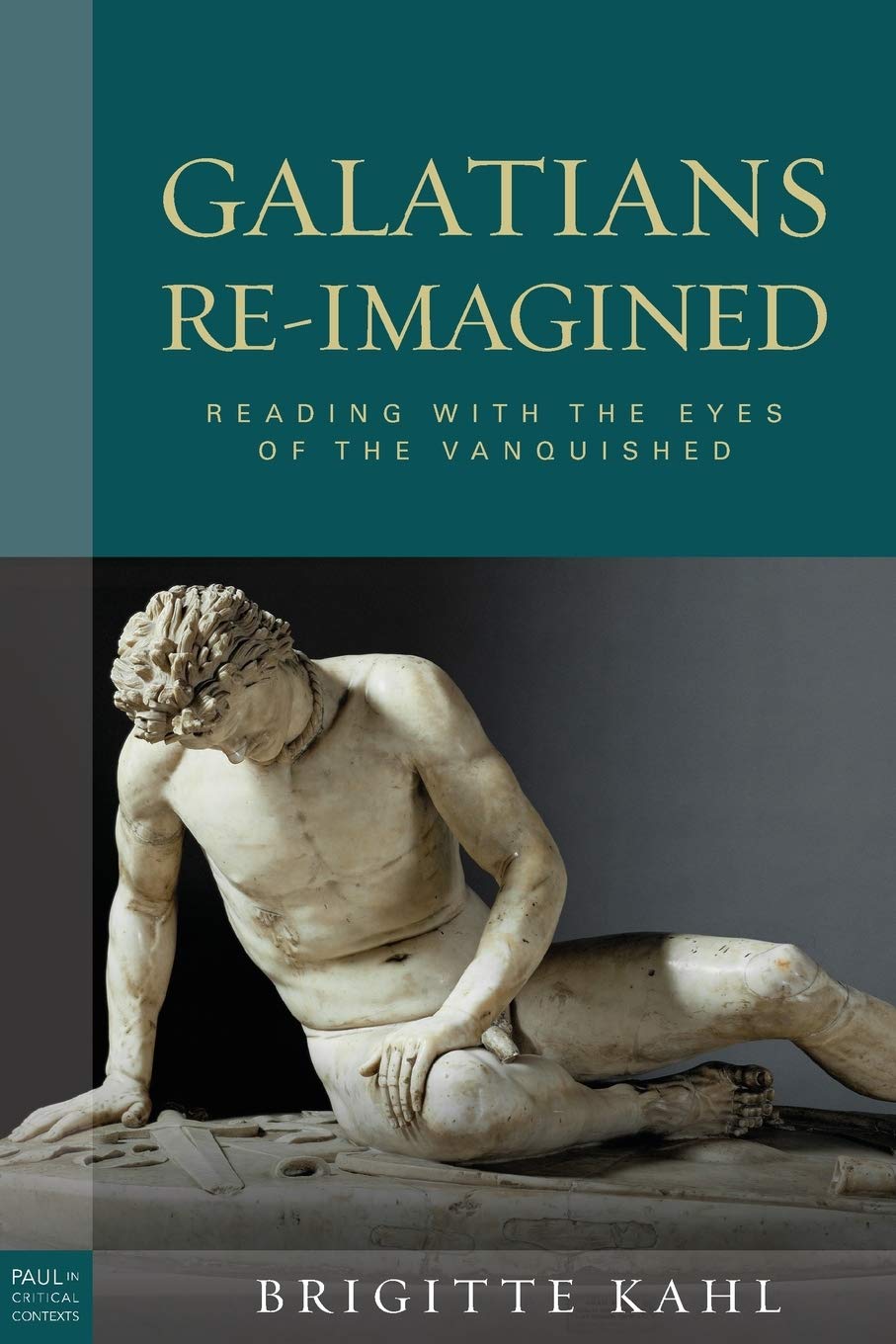
Book Report: Brigitte Kahl, Galatians Re-Imagined: Reading with the Eyes of the Vanquished

 Amazon.com: Galatians Re-Imagined (Paul in Critical Contexts)  (9781451488074): Kahl, Brigitte: BooksIn my time away from serving a local church, I have been catching up on reading and writing alternative worship services.  I usually read several books at one time because I found that I get bored easily and this was a compensation skill I learned early in my life.  If I get bored with one, I can turn to another.  And vice-versa.  So then I end up taking much longer but moving to completion on several books at one time.  For good or for ill, I then end up making connections and reading every book intertextually.  Speaking of intertextually . . .

I read Brigitte Kahl's book, Galatians Re-Imagined, in a cursory way some time ago to get myself ready to preach Galatians.  So I had her conclusions but did not have the incredible back story she provides for seeing Galatians with new eyes and therefore reinterpreting Paul as strongly anti-imperial and his teaching as grounded in his Judaism and within the context of the Roman Empire.  This book has profoundly moved me around the teaching of Paul.  I say that even after having read Richard Horsley and John Dominic Crossan on Paul.  Scholarship was moving this way.

I now have decided to teach New Testament by beginning with the first verse of the Gospel of Mark and then moving to Paul's letter to the Galatians.  This letter, with its radical baptismal formula, helps set the tone for reading of the gospels.  

'What scholars have to do, not unlike an attorney pouring over case law in a particular tradition, is sometimes do their best to ignore the long tradition in favor of a plain reading of the text in its matrix.  Paul was a Jew.  So believing that Paul is going to dismiss Jewish Law is really a stretch.  Paul also lived in the matrix of the Roman Empire, a slave society.  So when he goes on and on about freedom and slavery this is not him providing metaphors for a transcendent, spiritual life.  No.  On the contrary, Paul is citing what people know living under the boot of the Roman Empire.  We are slaves.  Life is hard.  The Roman Empire is doing its best to remind you that you are somehow less than human.  You are "other."

Kahl does a unique thing in this book.  She reads the book of Galatians with an eye toward The Great Altar at Pergamon.  The Attalid Empire constructed The Great Altar as a conveyor of culture, a statement about who was in and who was out, who was "human" and who was "perverse beast."  The Great Altar was later appropriated by the Romans to continue the tradition of using incredible artistic scale to communicate life as the Romans saw it.  

Rome and its gods were victorious bringing peace and justice over the barbarians, the outsiders, "the others."  Those "others," spanning over empires in the ancient world, were the Gauls or the Galatians, Kahl showing how Gauls and Galatians were used interchangeably as this "other" enemy to Rome and its gods.  Chiseled in to  The Great Altar at Pergamon are muscular Gauls/Galatians with nappy hair and serpent's tails.  The Roman gods come from above to bring about law and order amidst the intended chaos waged by the Gauls/Galatians.  

In one frieze, Athena is separating Gaia (coming up from the ground) from her son, Alkyoneus.  In effect, Athena is taking a son from his life source.  Nike also arrives from above to beat back the Gauls/Galatians.  These are strong cultural statements about how unseen, divine forces give validity and justification to who rules the world, who is human and who is not, and who is justified using violence to hold back the chaos.  

Kahl wants us to interpret a frieze like this as we interpret the book of Galatians.  She makes a strong case for Paul not being critical of Jewish Law or Torah but of Roman law.  Jewish Law was and is a way, a path, a vibrant interpretation of God's will and want for the material freedom of God's people and that Law was particularly robust around being a vanguard for the most vulnerable.  Roman law reminds people far and wide of their slave status (The Great Altar shows that the gods affirm that status quo.), who is in charge, and who is human.  

As we read Galatians then, we are reminded that Paul sends this letter to a people who have been historically "othered" by empires.  Not unlike our own country's racism, this "othering" has been communicated in such a strong cultural way that everybody knows it.  It is the soup in which all of the Roman Empire swims.  Once we read the letter to the Galatians as full of Roman language, we begin to see Paul repetitively flipping (maybe flipping off?) the culture in a resistance text.  Rome assumes the violence it preaches.  Paul seeks to dismantle it.  

We read in Paul's letter the baptismal formula that pre-dates him and is the response to this "othering."  There is neither Jew nor Greek, male nor female, slave nor free . . .  I've preached it several times but can we read just how radically counter-cultural that is even today.  Let me back up with it.  It is the antidote to othering.  There is no ethnic, gender or sexual identity, social position or economic status in your baptism.  Humans don't get othered.  

I have also chosen to read two of Paul's key terms, sarx and pneuma, in a light that makes much more contextual sense.  Unfortunately, they have become so loaded with the Christian tradition's preoccupation with sexuality that they have lost their power.  Sarx is translated as sex when what Paul is saying is alluding to shallow or empty values.  So I choose to translate sarx as is "skin-deep."  Pneuma , translated as Spirit, is about something or values that have deep and enduring meaning.   Paul is trying to locate sarx around our edges and locate pneuma deep in the heart or gut.  

With President Trump sound the alarm for "law and order" amidst meaningful protests and statements from Jacob Blake's family, how powerful is this text that tells us, once again, what empire is trying to do.  President Trump is signalling.  We are the civilized to bring order to chaos.  We are the humans.  You are the barbarian animals.  Therefore, our violence against you is justified.  Any harm, however small, is magnified to show once again that you are the perverted beasts.  

We watch that video of Jacob Blake and we know better.   See what some have tried to do to Jacob Blake?  They bring up a knife, recite crimes he may have done, all to suggest that he is "other", a barbarian that the State is justified in doing any kind of violence it chooses to him.  

Paul, in Galatians, recognizes that "law and order" as counter to the will of God.  Jacob's father repeated it over and over again in his first press conference.  "He is a human being.  He is a human being."  For a good portion of our country, that truth has yet to become real in their lives.  The Great Altar of Pergamon, reciting Roman victory over its enemies through violence,  is still a text read well by the people of our own country.  Roman military victories were pronounced as good news, as gospel by the ruling class.  We need another gospel.

Wednesday, July 10, 2019

Twelfth Sunday in Ordinary Time, June 30, 2019, "No distinctions made"


C Proper 7 12 Ord OL BFC NH 2019
Galatians 3:25-28; Gospel of Thomas 77
June 30, 2019

          The Bible is not the be all end all but today I want to begin by asking us to think of a Scripture verse you might consider a life’s motto or sums up the meaning of Christian faith.  Let’s take a minute of silence to reflect and then share.   A life’s motto found in a Scripture verse or a Scripture verse that you think sums up the Christian faith.   One minute of silence. 
 A life’s motto found in a Scripture verse or a Scripture verse that you think sums up the Christian faith.
One of the Scripture verses I might use to summarize Christian faith is found in Paul’s letter to the Galatians for today.  Paul writes in about the year 50 C.E., and Paul is clearly quoting something that pre-dates that.  It was used by early Christians in their baptisms and it conveys just how radical early Christianity was.  There is no distinction between those of different racial, ethnic, national, or religious stripe (Jews and Greeks).  There is no distinction between those of different gender or sexuality (male or female).  There is no distinction between those of different social or economic background or status. (slave or free). 
I think it is critical that we hear what a radical statement that was not only for the 1st Century but for the 21st Century.  Sometimes we wrongly assume that we have to bend and twist our tradition and Scripture to make some moral progress, to find a Christianity that is open enough, loving enough, and just enough to meet us where we are.  Sometimes that faith is calling to us from the ancient world to be much more radical than what we are.  This broad, baptismal statement tells this open and affirming congregation—with beautiful and wise and courageous leaders and participants from all across the LGBTQAI spectrum—that our work together, our ministry together, our lack of distinction in love, is central to the beginnings of the early Christian Church.  It is time we stop acting like we have to apologize for our faith.  By our identity and work in Billings and in Montana, we are at the heart of the Christian tradition, affirmed by its earliest creed, when we find spiritual power, divinity, God or Christ in diverse and various peoples, places, and voices.  This is who we are.
I was drawn to an article from CNN this week about Australian musician and songwriter, Nick Cave.  Cave’s music is characterized by its raw intensity, and, historically, its unflinching dark subject matter.  He cultivated an aloof and menacing persona.  Things changed somewhat, however, when Cave and his wife tragically lost their 15 year-old son.  Several years ago he began a dedicated search for a deeper faith, something less vengeful, and became witness to a Jesus who was a man of sorrows, sadder, softer, more introspective.  And seven months ago, Cave began a conversation with his audience in concerts and on the internet which has him revealed as a wisdom-giver.  He encouraged people to ask him anything.  When asked what God sounds like, Cage responded by saying, "I hope the voice of God would be something other than booming, authoritarian and male," Cave answered. "Wouldn't that be a pleasant surprise?"  He reflected on his time in the recording studio, how various and diverse voices can come together to produce something like what he thinks God’s voice must sound like.  He went on.

Perhaps, God would have the combined voice of all the untold billions of collected souls, an assembly of the departed speaking as one -- without rancour, domination or division, a great, many-layered calling forth that rings from the heavens in the small, determined voice of a child, maybe; sexless, pure and uncomplicated -- that says 'Look for me. I am here.’[1]

Before The DaVinci Code became popular, the movie Stigmata was released, using the present verse from the Gospel of Thomas as its centerpiece.  The movie suggested that the Roman Catholic Church was preventing the  Gospel of Thomas from going public because it suggested that we did not need the church, a pastor or a priest, to know spiritual power, the Divine, God or Christ.  The divine was accessible to us by looking under a stone or splitting a piece of wood.  Church authorities didn’t want you to know that divinity was so readily available to you because church giving and attendance might bottom out. 
If you did not know this truth, I hope you hear it loud and clear now.  In Christ there are no distinctions.  God and God in Christ are actively trying to be known to us, to say, “Look for me.  I am here.”  Maybe we have missed out because we have been waiting for God from on high, in the powerful and the mighty, the large and impressive, to emerge from the sky.  Meanwhile, as the Gospel of Thomas relates, God has been active from below underneath the stone or from within, inside the log in the small and often unnoticed.  Perhaps it is not the stone or the wood that lead to answers but the lifting and the splitting that bring it about.  What lifting up a stone and splitting open wood requires of us is a strenuous searching.[2]  Christ is found in the strenuous seeking from below, underneath, and from within—the small.
I invite you to take a look at the photo on the front of your bulletin.  There lies a split log.  Looking in the log we find a skink:  a small lizard.  Skinks are very beneficial to a garden because their prey includes grasshoppers, snails, slugs, cockroaches and even small mice.  Who would guess that such a small, active creature might be found within the split log, a manifestation of the divine?
In her book, Emergent Strategies, Adrienne Maree Brown shares how we, as communities, can harness the strength of the small for spiritual power by paying attention to the patterns and the rhythms of the created world.  We should be like the fungus mycelium that grows underground and interconnected to create healthier ecosystems.  We should be like ants who act collectively and cooperatively, relying on the work of others.  We should be like ferns who repeat at scale to impact a whole system.[3]  We should be like a murmuration of starlings—chaotically yet beautifully finding ways to avoid the predators of the world by keeping the right distance apart while keeping our connectivity to move together as a unit.[4]  We should be like dandelions—hard to uproot, medicinal and healing, able to spread like wildfire over the best of lawns.  We are resilient, resistant, decentralized, and regenerative.[5] 
Were you told or taught that God makes distinctions such that your race, nation, ethnicity, or religion disqualifies you from receiving goodness, kindness, and love, and the material bases of life?  That distinctions about your gender or sexuality left you outside the circle, with Christ unable to be found?  That distinctions about your social or economic status or lack of noble birth and noble name somehow made you less than?  It is a lie.  A bold-faced lie—so that others might limit, abuse, torture, claim superiority over you and with their persistence make you believe it.  Were you told or taught that spiritual power, the divine, God or Christ was not available to you?  It is a lie.  A bold-faced lie—to keep you in line, to make you forget your own power. 
I say to you on this day.  Stop seeking God in palaces and in the velvety robes of kings and sovereigns, in the halls of presidents or congress.  Even more so, we are seeking to create a church and a movement that is not confined to the four walls of a church or is confined and boxed in a sanctuary.  In this congregation and out in this beautiful earth are the wonderfully diverse gifts of God.    Give your muscle and sinew, your seeking and activity to find God beneath and within, in the small and the hidden.  God wants to be found.  “Look for me.  I am here.”  Seek!
It is a bold-faced lie to suggest that there are distinctions, to say God or Christ is not available to us.  As the Islamic Sufi mystic, Rumi said, “You are not a drop in the ocean.  You are the entire ocean in a drop.”[6]  No distinctions made.  God’s power is made available to all of us in the small.  This is our tradition.  May we be like a murmuration of starlings, in boundaries and connection, chaotically and beautifully making our way.  Amen. 


[1] Daniel Burke, “A rock star was asked what God's voice sounds like. His answer is beautiful,” CNN, June 29, 2019, https://www.cnn.com/2019/06/29/world/nick-cave-god-religion/index.html. 
[2] “Early Christian Writings:  Gospel of Thomas Commentary,” http://www.earlychristianwritings.com/thomas/gospelthomas77.html
[3] Adrienne Maree Brown, Emergent Strategy:  Shaping change, changing worlds, (Chico, CA:  AK Press, 2017).
[4] Julian Scott Campbell, “Earing our place on the planet:  an interview with adrienne maree brown,” Longreads, April 2018, https://longreads.com/2018/04/24/earning-our-place-on-the-planet-an-interview-with-adrienne-maree-brown/.
[5] Brown, “Emergent.”
[6] “Emergence #3: nine practices into a new future,” Great Lakes Commons, October 5, 2018. 

Sermon, Year A, Second Sunday of Advent, "We need a story that saves us"

A Advent 2 ColPaul AL 2025 Matthew 1:1-17 December 7, 2025           I wanted to offer a trigger warning this morning knowing that we...