Earth Day

Showing posts with label Brigitte Kahl. Show all posts

Sunday, May 14, 2023

Sermon, Proper 5, "The Great Altar of Pergamon as macro-narrative"


C Proper 5
Galatians 1:11-24
Galatians 1:11-12

Ancients talked about the divine world, the activity of the gods, to explain how things are or why things are the way they are.  Or as a way of expressing how Divine activity was beginning to move or act in a way that either is in keeping with other stories or counters the dominant story of the time.  For the Jewish people, a people often beholden to an alien power, God was often moving counter to the dominant story of the time.  Paul shares this in our passage from Galatians today.

11 For I want you to know, brothers and sisters, siblings and cousins, that the gospel that was proclaimed by me is not of human origin, 12 for I did not receive it from a human source, nor was I taught it, but I received it through a revelation of Jesus Christ. 

Using the divine realm gives a story power and authority, a sense that what we participate in is a story bigger than ourselves—even etched in stone.

           Those who have been with me in Bible 101 studies know one of the original questions to ask of any Scripture verse is, “What is the macro-narrative, the defining story, the matrix or context?  And how do we know it?”  That larger question is answered with other power questions such as: 

·       Who owns the land?

·       Who owns the natural resources? 

·       Who has access to food and water and its distribution?

·       Who owns the means of production?

Those who tell the macro-story put the story in a prominent place, a place where the story might be seen and told over and over again.

One of the most common ways ancient societies told stories was through their architecture.  Paul’s gospel has a backdrop, a macro-narrative, to which he is responding in his letter to the Galatians.  Paul is telling the Christian gospel as a response to the macro-story or narrative of the Roman gospel and how their gods have ordained the status quo.

New Testament scholar, Brigitte Kahl, points to the architectural marvel of the Great Altar of Pergamon to help us better understand that Roman gospel.  Just to give you a sense of scope for how powerful that story was intended to be for people in the ancient world, here is a photo of the Great Altar of Pergamon at its moder-day home in Berlin.  Look at how huge that thing is!   The story written into that architecture is meant to dominate the landscape in the ancient world.

The historical matrix for the altar begins with the Attalid Dynasty at the time of the Seleucid Empire, at the end of the 3rd Century B.C.E.  Kahl writes:

 The historical background of the altar is a series of successful military operations of the Attalid dynasty of Pergamon directed against "marauding Gauls" towards the end of the third century B.C.E. In the battle scenes of the Great Altar, these historical Gauls became transformed into mythological "Giants" in order to celebrate the archetypal and universal dimension of Pergamon's victory over them. These are "our" Galatians. "Marauding Gauls" is a common name for them at this time. And, they are perceived as universal enemies and an almost cosmic security risk.

To understand this we have to keep in mind that the Greek word for "Galatians" (Galatai) covers Gauls and Celts in general.[1]


The Galatians were the “northern barbarians” found all over what we now call Western Europe and also found as far east as modern-day Turkey.  These barbarians troubled the Greco-Roman world for centuries.  Late in the 4th Century BCE, the Galatians forever seared themselves into Roman consciousness by conquering and burning Rome.  One hundred years later, in 279 BCE, savage tribes of Galatians attacked the Greek sanctuary of Apollo at Delphi, referenced as the navel or center of the world.  In another hundred years, in 189 BCE, “the Roman general Manlius Vulso, in a ‘pre-emptive’ and highly disputed military action, massacred or enslaved 40,000 Galatians, quoting them to be the notorious enemies of Rome all over the world and a permanent threat to Roman interests in Asia Minor, even if they had not taken up arms against Rome at this point.”[2]


Two decades after Manlius Vulso, the Great Altar is erected, to capture the order of things and enshrine the Galatians as the universal barbarians, ancient terrorists, the common enemy uniting empires across centuries.  The dominant story, the macro-narrative regularly refers to the Galatians as the terror et tumultus (the terror and the tumult). 

And so it was displayed at the Great Altar where the Galatians are portrayed as the vanquished, the defeated, the ones who come from the
ground up, the outside and below.  They are portrayed as the mythological Giants.  In the sacred victory over the barbarians, anarchy, the lawless, the Attalids have their gods, protectors of law and order, coming from inside and above.  The gods bring with them cosmic civilization over and against barbarism, law and order over and against lawlessness and chaos. 

Rome legally inherits the Great Altar and Pergamon becomes one of the early centers of the Roman imperial cult in Asia Minor.  The Roman gods transplant the Greek ones:  Zeus becomes Jupiter, Athena becomes Minerva, Nike becomes Victoria, Aphrodite becomes Venus.  The Great Altar not only comes to define the larger narrative for the Romans, the dominant people, New Testament Professor Adela Yarbro Collins believes the Great Altar defined Roman occupation for oppressed peoples like the Jews as well.  Collins believes the Great Altar is what is being referenced in Revelation 2, verses 12 through 16, as the “dwelling place” or throne of several identities fused into one, the throne of Satan, Jupiter, and Caesar.[3] 

John of Patmos writes in Revelation:

12 “And to the angel of the church in Pergamum write: These are the words of him who has the sharp two-edged sword:

13 “I know where you are living, where Satan’s throne is. Yet you are holding fast to my name, and you did not deny your faith in me even in the days of Antipas my witness, my faithful one, who was killed among you, where Satan lives.

From the Roman perspective, the Great Altar was a reminder of your social location, who is in and who is out, who are the sons of the gods and who are the others, the outsiders.  We learn from the Great Altar, before we even think about it, who brings law and order, and who brings terror and tumult.  The Jews, especially during the First Century, had become fused with the Galatians, the barbarians, the other, it was seen as the throne of Satan, the story of how the Romans justified their domination and violence against the Jews.  In response to Rome as the first commercial empire, using debt to leverage the loss of land, a people who understood land as given to them as a gift of God would respond.  Several times the Jewish people revolted against Rome.

           Again,  take a look at the Great Altar of Pergamon.  Presently, it is found
at a museum in Berlin.  And one can see how huge and imposing, its immensity as a communicator of Roman law and order. 


This is a frieze or a panel showing Athena, the goddess of Pergamon, and Nike, the winged goddess of victory, doing battle.  They ascend from on high, calmly in command, Athena with her hand in the nappy-headed hair of Aeschylus, the son of Gaia being separated from his mother who is coming up out of the earth from below.  As legend would have it, Alkyoneus was considered immortal as long as he remained in contact with the earth, his mother’s energy flowing through him.  Many of these giants like
Alkyoneus are portrayed as sub-human, beastly, large serpent tails, trailing behind them. 

In this frieze, Athena begins to lift Alkyoneus off the ground, separating him from his life force.  Athena and Nike are imposing their righteous will.


This frieze, although damaged, shows the domination of the gods over against the Giants.  Aphrodite, the goddess of civic order and war, is above these two Giants who appear in defeat and humiliation.  This close-up clearly shows her foot pressing down on the face of a Giant.  This is the sandal on the face, what we have come to say in the modern parlance, the figurative boot on the neck, the knee pressed down on the neck to not only indicate who is in charge but who can take life at a whim.

 In this frieze, one can see the goddess Hecate (right) fighting the Giant Clytus with his
serpent tail.
   And the goddess Artemis (left) fighting the Giant Otos with her dog biting the neck of another Giant on the ground.   

Once again, the gods hold the upper position fighting against Giants whose animal-like qualities, including those serpent tails, are emphasized to tell us the position of the Seleucid gods and their progeny and the social position of the sub-human social location of the Giants and their progeny, the Galatians. 

I know this is much more history than what you bargained for in a Sunday sermon.  But Paul’s letter to the Galatians is one of the earliest written books we have in the New Testament, and Paul quotes within it the earliest baptismal formula we have in Christianity.  How is Christianity defining itself some twenty years after the death of Jesus, probably twenty years before the earliest gospel is written?  How does Christianity understand itself in relation to its cultural matrix or context? 

Paul’s letter to the Galatians is also critical because it has been widely understood as dismissing Jewish legalism in favor of Christian freedom.  When we never see Paul dismiss or renounce his Jewish faith in his New Testament writings, why would we believe he would dismiss the Mosaic covenant or the Law, a central identity for the Jewish people?

With recent scholarship, focusing particularly on Paul’s choice for the word “law,” we know he is focusing on Roman law and order.  If he is critiquing Jewish Law, he is only doing so to critique the way Roman law and order has co-opted Jewish Law to become about who is in and who is out, who brings civilization and order, and who brings terror and tumult.

The Great Altar at Pergamon tells us not just how the Seleucid and Roman Empire organized themselves but also tells us how imperial projects organize themselves in making a group of people the down and out, the other, and then developing a divine narrative which sanctifies State violence against them. 

Who do we call barbarian, terrorist in our time to justify severing then from their life force?  How do we justify the use of law and order to maintain what we call civilization with what we believe to be divinely ordained brute force?

In Paul’s letter to the Galatians, he proposes an alternative to the macro-narrative found at the Great Altar of Pergamon, a Roman narrative that justifies pre-emptive force to slaughter people, wipe whole peoples off their land, and believe that the gods have thus sanctioned the “othering” of another people as subhuman, the spilling of blood in the name of the gods, and even the destruction of the earth, a separation from our own life force. 

Justification for divine blessing in the Roman story is done through violence against peoples we presume to be barbarians--violent, marauding, terrorists, beastly, less than human. 

The Roman gospel said that there were some ethnicities that were insiders and other ethnicities that were less than human.  There were some socio-economic classes that were acceptable and some that the gods did not find to be of any worth.  In a patriarchal system, even with female goddesses, men were deserving of public power with a divine right to navigate the world and its choices but women were not. 

Another note on that original frieze I showed you, with Athena, the goddess of Pergamon, separating the Giant, Alkyoneus, from his source of power, the earth, defined by his mother, Gaia.  Athena has her hand in his hair, lifting him from the earth.  Many of you probably know that Gaia has come to be known, traditionally, as Mother Earth. 

Not surprisingly, what the Great Altar of Pergamon also represents is a domination of and violence toward the earth itself, to bring it under control.  Too often, historians have associated dominating, violent, slave societies with advanced civilizations:  Egypt, Greece, Rome. 

When Rome came into being in about 750 BCE, the soil was richly fertile for a wide variety of food:  olives, figs, and grapes, peaches, apples, and pears, almonds, walnuts, and chestnuts.  Gradually, though, certain Roman philosophers began advancing the gospel that human technical skills could engineer “a second world within the world of nature.”  Rome therefore pressured the good earth to produce more and more.  Roman agronomists advocated plowing even more than once a year to save on labor.  That plowing led to greater and greater erosion.  Once flourishing towns declined and their populations left.[4] 

Eventually, that erosion and degradation of the earth became so precipitous that the Roman Empire could only feed its people by conquering new territory where fertile topsoil was still available.  David R. Montgomery, professor of geomorphology at the University of Washington, writes, “Rome didn’t so much collapse as it crumbled, wearing away as erosion sapped the productivity of its homeland.”[5]

Rome’s history is a reminder that the universe is not woven together on the backstrap loom of violence, domination, and warfare.  In the end, if not only Gaia’s son but any of us are separated from earth as our source and power, life will not be sustainable. 

Rome maintains their law and order through threats, actual violence, and armed warfare.  The gods ordain it, justify it, bless it.  The question for us, as people who come to church to say we believe in the gospel of the crucified and vanquished is whether our faith is justified in solidarity with the gospel of Christ?  Or, are we justified in another way, a far more violent way, that says our path is made and secured through violence, domination, and the boot on the neck of people we presume to be barbarians?  Paul’s letter to the Galatians knows the Roman story.  And he does not want his Jewish faith co-opted by it.  Paul writes of a different gospel.  To which gospel will we give our loyalty?  I pray we choose Christ crucified.  I pray.  Amen.


[1] Brigitte Kahl, “Reading Galatians and Empire at the Great Altar of Pergamon,” Union Seminar Quarterly Review, p. 24.

[2] Ibid, p. 25.

[3] Ibid, p. 26.

[4] Jay Griffiths, “Dwelling on Earth,” Emergence Magazine, https://emergencemagazine.org/essay/dwelling-on-earth/, October 3, 2019

[5] David R. Montgomery, dirt:  the erosion of civilizations, (Berkley:  University of California Press, 2007), p. 5.

Friday, August 28, 2020

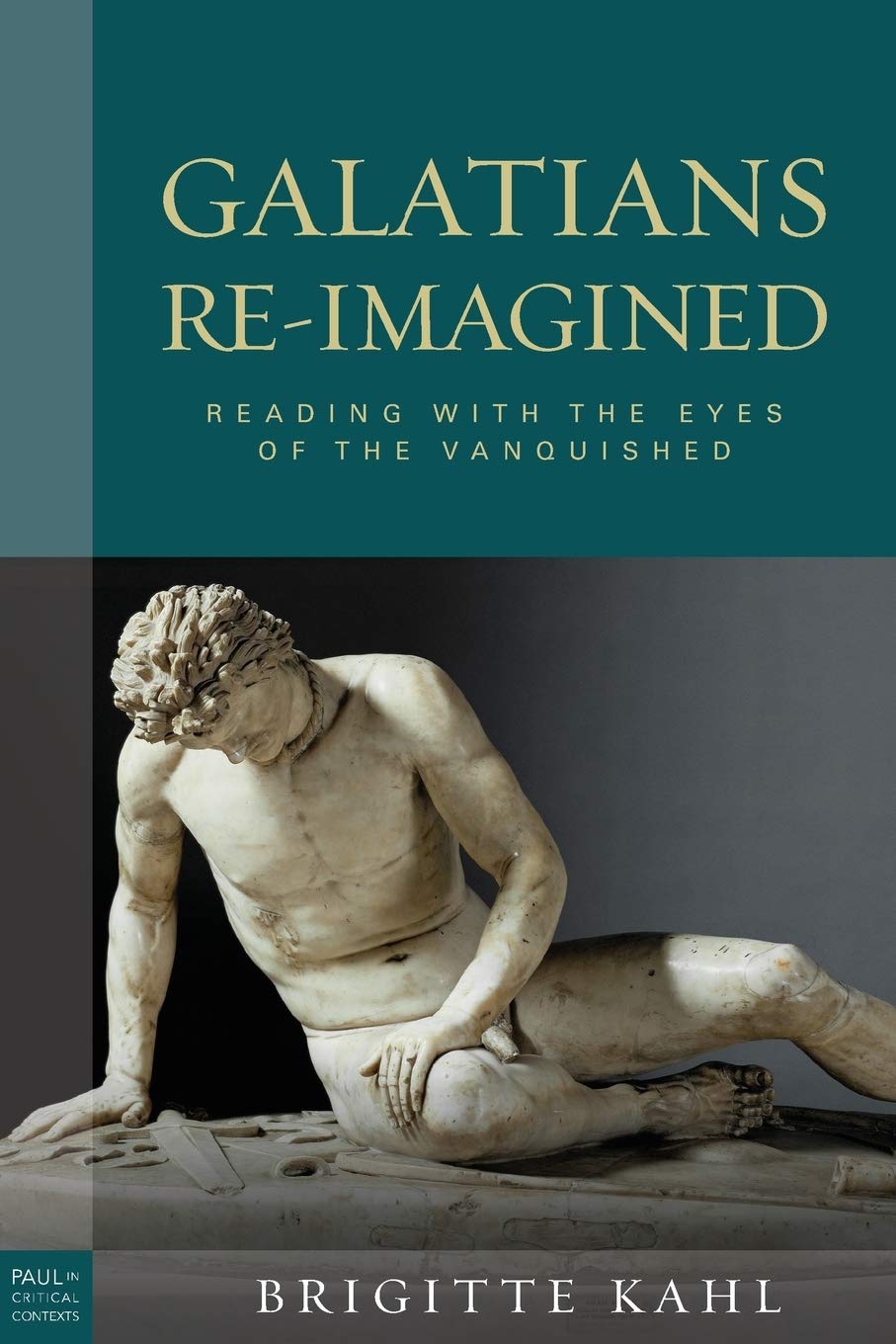
Book Report: Brigitte Kahl, Galatians Re-Imagined: Reading with the Eyes of the Vanquished

 Amazon.com: Galatians Re-Imagined (Paul in Critical Contexts)  (9781451488074): Kahl, Brigitte: BooksIn my time away from serving a local church, I have been catching up on reading and writing alternative worship services.  I usually read several books at one time because I found that I get bored easily and this was a compensation skill I learned early in my life.  If I get bored with one, I can turn to another.  And vice-versa.  So then I end up taking much longer but moving to completion on several books at one time.  For good or for ill, I then end up making connections and reading every book intertextually.  Speaking of intertextually . . .

I read Brigitte Kahl's book, Galatians Re-Imagined, in a cursory way some time ago to get myself ready to preach Galatians.  So I had her conclusions but did not have the incredible back story she provides for seeing Galatians with new eyes and therefore reinterpreting Paul as strongly anti-imperial and his teaching as grounded in his Judaism and within the context of the Roman Empire.  This book has profoundly moved me around the teaching of Paul.  I say that even after having read Richard Horsley and John Dominic Crossan on Paul.  Scholarship was moving this way.

I now have decided to teach New Testament by beginning with the first verse of the Gospel of Mark and then moving to Paul's letter to the Galatians.  This letter, with its radical baptismal formula, helps set the tone for reading of the gospels.  

'What scholars have to do, not unlike an attorney pouring over case law in a particular tradition, is sometimes do their best to ignore the long tradition in favor of a plain reading of the text in its matrix.  Paul was a Jew.  So believing that Paul is going to dismiss Jewish Law is really a stretch.  Paul also lived in the matrix of the Roman Empire, a slave society.  So when he goes on and on about freedom and slavery this is not him providing metaphors for a transcendent, spiritual life.  No.  On the contrary, Paul is citing what people know living under the boot of the Roman Empire.  We are slaves.  Life is hard.  The Roman Empire is doing its best to remind you that you are somehow less than human.  You are "other."

Kahl does a unique thing in this book.  She reads the book of Galatians with an eye toward The Great Altar at Pergamon.  The Attalid Empire constructed The Great Altar as a conveyor of culture, a statement about who was in and who was out, who was "human" and who was "perverse beast."  The Great Altar was later appropriated by the Romans to continue the tradition of using incredible artistic scale to communicate life as the Romans saw it.  

Rome and its gods were victorious bringing peace and justice over the barbarians, the outsiders, "the others."  Those "others," spanning over empires in the ancient world, were the Gauls or the Galatians, Kahl showing how Gauls and Galatians were used interchangeably as this "other" enemy to Rome and its gods.  Chiseled in to  The Great Altar at Pergamon are muscular Gauls/Galatians with nappy hair and serpent's tails.  The Roman gods come from above to bring about law and order amidst the intended chaos waged by the Gauls/Galatians.  

In one frieze, Athena is separating Gaia (coming up from the ground) from her son, Alkyoneus.  In effect, Athena is taking a son from his life source.  Nike also arrives from above to beat back the Gauls/Galatians.  These are strong cultural statements about how unseen, divine forces give validity and justification to who rules the world, who is human and who is not, and who is justified using violence to hold back the chaos.  

Kahl wants us to interpret a frieze like this as we interpret the book of Galatians.  She makes a strong case for Paul not being critical of Jewish Law or Torah but of Roman law.  Jewish Law was and is a way, a path, a vibrant interpretation of God's will and want for the material freedom of God's people and that Law was particularly robust around being a vanguard for the most vulnerable.  Roman law reminds people far and wide of their slave status (The Great Altar shows that the gods affirm that status quo.), who is in charge, and who is human.  

As we read Galatians then, we are reminded that Paul sends this letter to a people who have been historically "othered" by empires.  Not unlike our own country's racism, this "othering" has been communicated in such a strong cultural way that everybody knows it.  It is the soup in which all of the Roman Empire swims.  Once we read the letter to the Galatians as full of Roman language, we begin to see Paul repetitively flipping (maybe flipping off?) the culture in a resistance text.  Rome assumes the violence it preaches.  Paul seeks to dismantle it.  

We read in Paul's letter the baptismal formula that pre-dates him and is the response to this "othering."  There is neither Jew nor Greek, male nor female, slave nor free . . .  I've preached it several times but can we read just how radically counter-cultural that is even today.  Let me back up with it.  It is the antidote to othering.  There is no ethnic, gender or sexual identity, social position or economic status in your baptism.  Humans don't get othered.  

I have also chosen to read two of Paul's key terms, sarx and pneuma, in a light that makes much more contextual sense.  Unfortunately, they have become so loaded with the Christian tradition's preoccupation with sexuality that they have lost their power.  Sarx is translated as sex when what Paul is saying is alluding to shallow or empty values.  So I choose to translate sarx as is "skin-deep."  Pneuma , translated as Spirit, is about something or values that have deep and enduring meaning.   Paul is trying to locate sarx around our edges and locate pneuma deep in the heart or gut.  

With President Trump sound the alarm for "law and order" amidst meaningful protests and statements from Jacob Blake's family, how powerful is this text that tells us, once again, what empire is trying to do.  President Trump is signalling.  We are the civilized to bring order to chaos.  We are the humans.  You are the barbarian animals.  Therefore, our violence against you is justified.  Any harm, however small, is magnified to show once again that you are the perverted beasts.  

We watch that video of Jacob Blake and we know better.   See what some have tried to do to Jacob Blake?  They bring up a knife, recite crimes he may have done, all to suggest that he is "other", a barbarian that the State is justified in doing any kind of violence it chooses to him.  

Paul, in Galatians, recognizes that "law and order" as counter to the will of God.  Jacob's father repeated it over and over again in his first press conference.  "He is a human being.  He is a human being."  For a good portion of our country, that truth has yet to become real in their lives.  The Great Altar of Pergamon, reciting Roman victory over its enemies through violence,  is still a text read well by the people of our own country.  Roman military victories were pronounced as good news, as gospel by the ruling class.  We need another gospel.

Tuesday, June 14, 2016

Sermon for the 11th Sunday in Ordinary Time, "The Jewish Law of neighborliness becomes the Roman law of exclusion and violence"

C Proper 6 11 Ord BFC 2016
Galatians 2
June 12, 2016

As many of you know, I consider Rabbi Sharon Brous, leader of the IKAR community in Los Angeles, one of my unilateral spiritual directors.  Unilateral in that the only give and take has been her gracious response to a few emails I have sent her way.   I consider her one of our country’s spiritual leaders.  When I listen to her podcasts, my heart is fully open to hear the Truth—richly, fully. 
Rabbi Brous’s writing and preaching spawn courage in me, articulate things I already know, and work out the Heart of God for me.  But several weeks ago I listened in on one of the podcasts in which she asked Reza Aslan, Western Muslim intellectual and author, to reflect on the state of the world’s affairs for her Jewish congregation.  I have heard Mr. Aslan on CNN and listened to his summation of the book he wrote about the historical Jesus, Zealot.  Though I disagree with some of Aslan’s conclusions, I appreciate and welcome his thoughtful work on faith and religion.  That is, until I heard the podcast.  And the podcast led me to a place of despair and hopelessness. 
Reza Aslan was asked to define the people behind and involved with Al Quaeda and Isis, these two Muslim groups who use terror and violence to make their way in the world.  While Aslan said that we knew what Al Quaeda was all about because it is a group filled with intellectuals, which has been around, and taken pains to print their beliefs and understandings, ISIS is too recent, unschooled, and seemingly not as concerned with sharing their beliefs with the rest of the world.  Then came an unfortunate turn.  Mr. Aslan stated that what we are finding out is that the understandings and theology of ISIS, an ideology which is broader than nationalism, has no value or hope for life on this planet.  So Aslan, argued, ISIS’s theology puts them in a place where there is no negotiation.  We must kill them.  But we, the United States, must not be the ones who kill them.   He was enthusiastically affirmed by the Jewish community in the room. 
I don’t know what came over me.  I felt my heart fall into my stomach.  Internally, I found myself weeping.  I’m not naïve.   I spend time going back and forth as to whether I think nonviolence is pragmatic in a world where the only resource some people have to end their suffering and death is to fight back.  But I just heard a Muslim intellectual and scholar, totally divorced from the context in which ISIS was born, namely our pre-emptive war without reason in Iraq, say he didn’t know about ISIS and then reverse course and say they had to be violently eradicated, preferably not by us.  We represent order.  They represent lawlessness.  We represent civilization.  They represent barbarity.  We represent harmony.  They represent anarchy.  He didn’t know.  And then he provided the imperial cookbook for how the conquered are to be known.  We/them.  
I think I was receiving this information so much with my whole heart that my critical brain was catching up only to find my heart empty and scarred.  I felt adrift and lost.
In the last two weeks, I have been trying to tackle one of the most mythologically loaded books of the Bible.  The body of that letter is found in chapter 3, verses 27 through 28: “You are no longer Jew or Greek, slave or freeborn, male and female.  Instead, you all have the same status in the service of God’s Anointed, Jesus.” 
In the sermon two weeks ago, I began by talking about the broad meaning of Paul’s letter to the Galatians as one that asked us to be open to God’s world-transforming news, to say “yes and” or “yes please” and participate in seeing those we are told as “other” as welcome at the table.
          Rather than clutching, clawing, and drawing unnecessary boundaries which prevented our ability to see the new thing that God was doing, Paul invoked the most ancient baptismal formula of the church to find our unity regardless of race, ethnicity, culture, or religion (Jew or Greek), our common cause regardless of economic or social status (slave or free), our mutual ministry regardless of gender or sexual polarities (male or female).  I hesitated to share that with you because issues of race, ethnicity, cultural, religion, economic and social status, and gender or sexual polarities have all been solved and are rarely seen in the news today. 
          Last week I shared some of Paul’s matrix or context to show you the violence in the friezes of the Great Altar of Pergamon, the Hellenistic theology appropriated by Rome to represent themselves and their Caesars as sons of the divine, to justify and make sacrament the violence over and against people they portrayed as the uncivilized, the transgressors of boundaries, the savages, the barbarians.   In Hellenistic theology, the broad name for these barbarians was the “marauding Gauls” or the Galatians. 

In 189 B.C.E. the Roman general Manlius Vulso, in a "pre-emptive" and highly disputed military action, massacred or enslaved 40,000 Galatians, quoting them (according to Livy) to be the notorious enemies of Rome all over the world and a permanent threat to Roman interests in Asia Minor [modern day Turkey], even if they had not taken up arms against Rome at this point (Livy 38.12-39.7).[1]

Manlius Vulso believed he was saving the world from the Galatians.  In Vulso’s victory speech, he references the Galatians over and over as terrorists.  Ancient Greek and Roman writers were unified in referring to the Galatians as the people of “terror et tumultus” (terror and tumult, or fear and confusion).[2]  I hesitate to share this with you because I’m not sure there is a historical people close by we called “savages” to justify historical violence;  or a recent pre-emptive war, with highly disputed military action, we waged because we whitewashed history to refer to a people as terrorists.  The Bible and its teaching can be so archaic.  (deep sigh)
          This is the setting for this third reading from Galatians, one where an intra-Jewish dispute has Jews from Jerusalem changing the behavior of Cephas by the invoking of Jewish Law.  Throughout Hebrew Scripture or the Old Testament, the Jewish Law is a source of grace, and beauty, and neighborliness.  It brings life to the Jewish community and holds out an identity for the Jewish people when conquering nations demand that Jews abandon their faith to serve foreign rulers and foreign gods.  The Jewish Law created “a space of nonaccommodation to foreign rule and religion.”[3]  The apostle Paul believes, however, that Roman law and order has co-opted Jewish Law.  The two have become conflated.  Roman law and order reminded the populace who was in and who was out, who was legitimate and illegitimate, who was Roman and who was other.  Empires create necessary divisions to surveil and control the populace.   In the First Century, the difference, the unaccommodated space between what the Jewish Law and the Roman law and order do, in Paul’s eyes, becomes unidentifiable.
          In the passage that Aaron read for us today, the apostle Paul is chastising Cephas for his hypocrisy.  Cephas was regularly breaking bread with Gentiles when Jews with more exacting interpretations of Jewish Law arrive in Antioch.  Cephas stops eating with Gentiles.  By doing so, Paul believes, Cephas does not what the Jewish Law requires, but interprets Jewish Law to be a mere imitation of Roman law and order.  Empire divides between insiders and outsiders, winners and losers, the victorious and the vanquished.  Christ . . . unifies.  The world-transforming message says that there is no insider and outsider, no legitimate and illegitimate.  We could go on and on—no documented and undocumented, no Christian and Muslim, no conqueror and collateral damage.
          Paul believes that true religious faith and loyalty which reflected a neighborliness that commanded his people to see the widow, the orphan, and the stranger as part of Jewish community has been captured by a Roman civil religion which feels, sounds like, and acts in a way that draws lines, foments division, and excludes people from the table.  Could it be that Jewish Law not only sounds like Rome and its Caesars but also like Egypt and its Pharaohs?  Is God indistinguishable from the will of Rome and its Caesar?  Is the primary focus of the Jewish Law to provide a simple morality play where we decide who is in and who is out, who is civilized and who is barbarian, who is righteous and who is transgressor, who is citizen and patriot and who is foreigner and terrorist?  Is that what religious faith is to be all about?  Again, I hesitated to bring this to you because I’m not sure there is a modern day example of a people who have been co-opted by a civil religion which seems to value, above all other things, determining who are the chosen, righteous few and who are the unclean and impure.  It probably sounds unfamiliar to you, in our day, that the unclean and impure, by their very immoral and savage existence, will bring calamity and natural disaster from a God who must be equally just as loving.   God, not unlike Caesar, stands over the world waiting to give a “thumbs up” or “thumbs down” through hurricane, flood, and earthquake. 
          Paul sought to distinguish Jewish faith and life apart from Rome.   All satire aside, it would appear that a large portion of our culture missed Paul’s necessary critique and has appropriated the religion of Roman law and order.   In the religion of Roman law and order, our main task is to find a way to become “an insider” away and apart from the unbelievers, heretics, the lame and the leper who cannot drag themselves to the pool for healing, the outsiders, the people who clamor at the border.  This form of Roman law and order then has the enforcers of it, covering their ears, seemingly immune to the pain they have caused, “Make them stop screaming!  Why are they causing trouble?  Do they not understand the limited, divine resources we have?  The great unwashed masses teem at our shores and borders.  For heaven’s sake, we have only so many bread and circuses for these barbarians!  Shut . . . them . . . up!”
          So though we may have created the need through war, climate change, or embargo, when this becomes our language, when we have adopted the Roman theology, it is only a short hop, skip, and a jump to justifying whatever violence we deem necessary to institute our form of culture and civilization. 
          In contrast, I believe Paul, as a Jew, is calling people to a faith described by activist Audre Lorde, “It is learning how to stand alone unpopular and sometimes reviled, and how to make common cause with those others identified as outside the structures in order to define and seek a world in which we can all flourish. It is learning how to take our differences and make them our strengths. For the Master's tools will never tear down the Master's house. They will temporarily beat him at his own game, but they will never enable us to bring genuine change . . . .”[4]
For people and institutions of Roman law and order, salvation was and is found in the heavy-handed legions who kill the Galatians before they actually became a threat.  They do violence against others promising that the others will eventually do violence against them.  They impose law and order against the O/other by standing guard outside of bathrooms.  They speak of the law and order of God coming in floods, hurricanes, and earthquakes to vanquish the sinful.    They tell us to be afraid, very afraid, seeking to project their terror on others so that they never slow down to see themselves fearful, quaking in their own shoes. 
As people who wish to stand within the tradition of Jesus the Christ and his ambassador, Paul, how are we then to be in the world?  For people within the apostle Paul tradition, people of loyalty to Jesus as Anointed, we need to be aware of Roman behavior.  Beware.  Beware the name-callers.  We learn over time that name-callers are calling people “marauding Gauls” or “terrorists” as a prelude to institutional or State-sanctioned, justified, and sacralized violence.  Beware. 
People of the Pauline tradition also know that the world is not to be divided into saints and sinners, the righteous and the infidel, the Sons of God who can justify their violence from above to quell the rebel violence from below.   Salvation is a refusal to see the world in these binaries.  And we look for salvation among the outsiders who refuses to see themselves as other.  We begin to see them as angels in the architecture.  These angels in the architecture are people who sees the world as one,  join in common cause, make mutual ministry.  It is Malala, the Muslim girl who refuses to see herself as “other” to say that women should not be excluded from the table of education.  With a heart the size of God’s heart she says, “I don’t want revenge on the Taliban.  I want education for the sons and daughters of the Taliban.”[5]  It is Malcolm X who returned from his pilgrimage to Mecca to understand the world as one and threatened even the powers within his faith who wished the sanctification of violence to continue.[6]  It is Muhammad Ali who knew that if he registered for the draft he would never be sent to Viet Nam but become a poster child as a celebrity-athlete for the war in Viet Nam[7], he refused to see himself as separate, apart.

Why should they ask me to put on a uniform and go 10,000 miles from home and drop bombs and bullets on Brown people in Vietnam while so-called Negro people in Louisville are treated like dogs and denied simple human rights? No I’m not going 10,000 miles from home to help murder and burn another poor nation simply to continue the domination of white slave masters of the darker people the world over. This is the day when such evils must come to an end. I have been warned that to take such a stand would cost me millions of dollars. But I have said it once and I will say it again. The real enemy of my people is here. I will not disgrace my religion, my people or myself by becoming a tool to enslave those who are fighting for their own justice, freedom and equality.[8]
 As sports columnist Dave Zirin said, Ali was not just for peace, he was against empire.    It is Yusuf Islam, one of the pallbearers at Ali’s funeral, formerly known as Cat Stevens, who took us back to a time when we were all one,  to remind us when morning had broken.       
As people of Paul’s religious tradition, our task is not to beat back Rome so that we might declare ourselves the new insiders.  Rather, we are to say that the dichotomies of winners and losers, civilized and barbarian, clean and unclean, sinner and saint, hold no value in the arms of a God who seeks our peace and well-being.  We cast our lot with those found outside Rome’s walls, along its shores, lying outside its borders to remember the faith of our Anointed, the Christ, who found common cause among the sinner, the forgotten, the misshapen, and the vanquished, even to the point of his death on a cross.  As he hung from that cross, he drew the curtain back for a criminal to tell him that God’s paradise was wide and broad and more expansive than he could ever imagine. 
          I depend on that faith to be true knowing that I am too often found giving lip service to the gospel of Christ and serving the gospel of Rome.  Next week we listen to the body of Paul’s letter where we come front and center with that baptismal formula:  neither Jew nor Greek, slave nor free, male nor female in serving Jesus Christ. 
I am hesitant to share it with you.  Living in the midst of Rome, you might think it nonsensical and archaic.  Or . . .you might just hear the world-transforming news for the first time, take it as your own, and begin to see people who are not like you in ethnicity, culture, or religion, economic and social status, sexuality or gender, as . . .your neighbor.  And if or when you do, may the scales fall from your eyes so that you see the wide, broad, and expansive arms of God as She welcomes you home. 
In the Muslim tradition, it is the season of Ramadan, a time when Muslim people all over the world fast to remember their common lot with the poor and hurting of the world.  They break their fast at the end of the season by inviting everyone around the table for a huge feast, a reminder that we are all one in our fasting and feasting.  As Jesus the Christ taught us, these are our neighbors.  We are one.  Praise God.  Amen. 


[1] Brigitte Kahl, Galatians Re-Imagined:  Reading with the Eyes of the Vanquished (Minneapolis:  Fortress Press, 2010), pp. 62, 65.
[2] Ibid, p. 74.
[3] Ibid, p. 215.
[4] Audre Lorde, “History Is a Weapon,” 1979, http://www.historyisaweapon.com/defcon1/lordedismantle.html.
[5] Ashley Fantz, “Malala at U.N.: The Taliban failed to silence us,” CNN, July 12, 2013.  http://www.cnn.com/2013/07/12/world/united-nations-malala/.
[6] Pierre Tristam, “Malcolm X in Mecca:  When Malcolm Embraced True Islam and Abandoned Racial Separatism,” about.com, December 26, 2015.  http://middleeast.about.com/od/religionsectarianism/a/me080220b.htm.  “Throngs of people, obviously Muslims from everywhere, bound for the pilgrimage,” he’d begun to notice at the airport terminal before boarding the plane for Cairo in Frankfurt, “were hugging and embracing. They were of all complexions, the whole atmosphere was of warmth and friendliness. The feeling hit me that there really wasn’t any color problem here. The effect was as though I had just stepped out of a prison.” To enter the state of ihram required of all pilgrims heading for Mecca, Malcolm abandoned his trademark black suit and dark tie for the two-piece white garment pilgrims must drape over their upper and lower bodies. “Every one of the thousands at the airport, about to leave for Jedda, was dressed this way,” Malcolm wrote. “You could be a king or a peasant and no one would know.” That, of course, is the point of ihram. As Islam interprets it, it reflects the equality of man before God.
[7]“Interview with Dave Zirin, Don't De-Islamicize Muhammad Ali: Scholar Says Muslim Faith was Central to His Views on Racism & War,” Democracy Now!, June 10, 2016.  http://www.democracynow.org/2016/6/10/don_t_de_islamize_muhammad_ali.
[8] Muhammad Ali, “Muhammad Ali Speaks Out Against the Vietnam War:  1966,” Voices of a People’s History of the United States, ed. by Howard Zinn and Anthony Arnove.  (New York:  Seven Stories Press, 2004), p. 431.

Monday, June 6, 2016

Sermon for the Tenth Sunday in Ordinary Time, June 5, 2016, "Learning from the Roman newspaper."

C Proper 5 10 Ord BFC 2016
Galatians 1:11-24
June 5, 2016

        I’m sure many of you have heard that one of the pressing issues in the present presidential election is the amount of media coverage given to presumed Republican nominee, Donald Trump.  I think the conventional wisdom is that the amount of coverage has provided candidate Trump with a celebrity and popularity that has led to his nomination.   Such conventional wisdom recognizes the power of the Fourth Estate in our culture, how the media can drive and control not only the message but also the concerns and values of a nation. 
          Who controls the media then dictates our concerns and values.  That was never made so clear as when I was in Chiapas, Mexico, for the first return of refugees back to their homeland in Guatemala.  It was an incredibly historic day for a people, a nation, that had waited for so long.  Refugees in over 100 refugee camps would make the long bus ride back into their homeland.  Huge!  Big! 
The day before the historic return, Barb Wenger, the Witness for Peace volunteer, who had gracefully taken me in like a stray dog, led me out to the camp that was to start the historic return to Guatemala.  We came back to the city by hitching a ride from a BBC reporter.  Barb asked, “How will the coverage go?  Will the international media cover the full return?”  The BBC reporter was frightfully honest.  “We don’t do well with history that doesn’t follow a continuous news cycle.  The refugees will need to leave tomorrow.  They will need to arrive in Guatemala City by the next day.  The following day they will have to arrive at their destinations in Guatemala.  Otherwise, we will be pulled from the story.  As you know, the United States is about to invade Iraq.  And what the U.S. government pays attention to, we must pay attention to.  So unless we can prove that there is something to cover each day here, the United States government will probably dictate international focus and coverage.” 
          In the most extreme extension of “if it bleeds, it leads”, the violence and devastation wrought by war captures our attention like nothing else does.  And so it becomes our regular breakfast, lunch, and dinner not only for the news but also for gaming and the most popular movies.  “Captain America:  Civil War!” Because even the Avengers who are friends can’t find a way to talk out their problems.  They use violence and war to work through their issues.  I think Iron Man and Captain American would have been better to find a good therapist.  Use your words, boys!  Collateral damage in these superhero movies has become a small footnote to justify even more violence and war.  Are there people in those buildings being mowed to the ground?  But what we are being told, over and over again, is that justified, sacralized violence is the only thing that can save us.
          So it also was in the ancient world.  After the Roman armies levelled the city of Jerusalem in the year 70 C.E., they sacked it of all of its valuables and brought back the booty.  Rome also returned to the capital with 7,000 Jewish slaves to help build the Roman Colosseum including the Arch of Titus, a tribute to the Roman general who would soon become Roman Emperor.   And by becoming Emperor, Titus would take his place among the pantheon of the divine.  The Arch of Titus shows with great architectural detail the Romans marching off with valuables of Jerusalem, one panel clearly showing them carting off a menorah.  This then was the message.  Through the violence, carnage, torture, victory, and spoils of war, generals elevated themselves to divine status.  They became sons of God.  Christian origins scholar, John Dominic Crossan, wrote, “Roman imperial theology was advertised with poems and inscriptions, coins and images, statues, altars, and structures.  It was, Crossan states, “a multimedia context that could have learned but little from Madison Avenue.”[1]  As Seneca, the great Roman statesperson and philosopher from the first century wrote, “Religion is regarded by the common people as true, by the wise as false, and by the rulers as useful.”
          Indeed, Roman imperial theology, their talk of the gods and the sons of god, was about maintaining civilization against the barbarism that infringed upon its moral, cultural, and geographical borders.  Roman law was opposed by lawlessness.  Roman culture was opposed by savages.  And Rome made violence and war a sacred necessity to defend their boundaries against transgression.[2]  This imperial theology was not new to Rome. 
          Union Theological Seminary New Testament Professor, Brigitte Kahl turns to how Greek imperial theology set the stage for how Rome understood itself over and against the barbarians of their time.  And that can be found in a massive political and religious architectural piece from the 2nd Century BCE.  To guide us through some of this art work, I have asked my resident Greek mythology expert, Sophia Heilman, to share her observations and reflections of this work. 

The Great Altar at Pergamon, c. 170 BCE, from the Hellenistic Attalid dynasty.


Father Zeus slaying three giants.  In the many friezes, the greek gods
come from above while the giants come from below.  The Attalid dynasty, through their rulers, saw themselves as “sons of god” and therefore linked to their destiny.  Roman emperors took for themselves the titles god and “sons of god” and used this theology to understand the way they moved against other peoples or the Other as justified and sanctified by the divine.   State violence becomes sacrament.


“The monument of a dominant world order—and of a primeval world war. In manifold combat scenes of supreme artistic perfection the gods and goddesses of the Great Frieze are shown in battle against the Giants attacking from below. The deities above fight vigorously but in a composed manner, clearly victorious and in control. Their opponents, on the other hand, appear in all poses and stages of dying and dead as they are impaled, mauled, hacked and trampled down by the divine force. The hair of the defeated Giants is wild, their bodies are naked, rage and despair show in their faces. Lacking calmness, restraint and all the other features that mark their conquerors as superior and civilized, some of them are even depicted as half-beastly with nasty snake legs. We cannot miss the point that the battle unfolding before our eyes is the holy war of civilization protecting itself against barbarism. The order of the world and the whole cosmos is at stake.”[3]

The Pergamene city goddess Athena and winged Nike in battle against the earth goddess Gaia and her favorite son Alkyoneus.


“If we look at this image closely we can see how Athena from above tries to separate Alkyoneus, Gaia's favorite son, from his mother below, stepping between the two of them with her beautifully-draped knee, at the same time pulling him up by his hair. Legend has it that Alkyoneus must die the very moment he loses touch with mother Earth. The poison of Athena's snake is already entering his body, and his face is in pain.”[4]

Aphrodite, the goddess of love and beauty, steps on the face of a defeated Giant.  To the right, another snake-legged winged Giant is attacked by Eros from above.   


          Architecture such as this was, effectively, the media of its time, the massive and monumental thing you might see every day as you entered the city, walked to work, or went to buy essentials in the marketplace.  This was the Roman newspaper.  So you might ask, “What does the Great Altar at Pergamon have to do with Paul’s letter written to the Galatians some 200 years later?”  The Greek word for Galatians covers Gauls and Celts in general and are thought of, in general, as the “northern barbarians.”  These architectural panels relate the successful military campaigns of the Attalid dynasty over and against what were termed the “marauding Gauls.”[5]  These are the lawless, the savages, the defeated and the vanquished.  Carried on and co-opted into Roman mythology and world-view, the Galatians are the bearers of chaos into the law and order of Rome. 
          Ok, I know that is just a ton of mythology to put out there for us all to try and get a grip on for understanding the apostle Paul.  But my main point today is this.  We so strip the New Testament of its political context, backdrop, or matrix sometimes that we hand deliver it to people who think the world-transforming news is about who gets invited to heaven and who gets shunned into hell.  No!  We explain Paul as concerned with “faith versus works, grace against law, foreskin versus circumcision.”[6]  By doing so, we totally strip him of any concern for the real world.  We make him concerned about other-worldly things rather than the real, world-transforming news in which he sits, walks, and teaches. 
The world-transforming news, traditionally translated the “gospel”, was a word regularly used by Roman rulers to proclaim military victories in the here and now.  And ambassadors and teachers like Paul were trying to say that the Jewish gospel understood through the lens of Jesus had to be understood in a radically different way.  Jesus, crucified, as Paul preached him, was one of the vanquished and defeated, one of the barbarians at the border, one of the savages undercutting culture, one of the lawless usurping Roman law and order. 
          Paul was not preaching who gets invited to heaven and shunned to hell.  Paul was saying that the world-transforming news is all about who gets invited to the table, who gets to share bread, who gets to partake in the resources for earthly life and sustenance and joy.  Paul writes that the shunned are those who would use law and order to keep others from the table.  And lo and behold, Paul uses a pre-existing baptismal formula to say that the lawless, the savages, the barbarians, the vanquished and defeated all get invited.  And get this:  the host of that feast is the most vanquished, defeated, barbaric, savage, lawless person you can imagine.  Rome crucified him as a way of saying that violence and war carry the day.  Other-centered and other-hearted people said that there is a God who comes from below to raise up a mission and ministry that is greater than war and violence. 
          So today, we say, we proclaim, that if you feel excluded through cultural norms that have you feeling like you are on the outside looking in, this meal is for you.  If you belong to a race or a culture or a religion that does not fit into the official religion that sanctions death, war, and violence, this meal is for you.   If you feel odd or strange or misplaced or struggling with a culture that wants you to achieve, go deeper into debt, shop until you drop, and work until you can barely scrape by, this meal is for you.  Share in the Anointed’s baptism and eat at the Anointed’s table.  For Paul teaches that the world-transforming news is that Christ’s table blurs the boundaries of law and order, breaks down the walls of civilization, calls into question what it means to be a savage, and de-bases a world view that legitimizes violence and war against the already defeated and vanquished.    The world-transforming news is:  this meal is for you, as a sign and seal of God’s intent for your sustenance, life, and joy.  Praise God!  Amen. 


[1] John Dominic Crossan, In the Shadow of Empire:  Reclaiming the Bible as a History of Faithful Resistance (Westminster John Knox Press, 2008), Richard Horsley, ed., p. 61.
[2] Brigitte Kahl, Galatians Re-Imagined:  Reading with the Eyes of the Vanquished (Minneapolis:  Fortress Press, 2010).  I find Kahl’s conclusions around Galatians nothing short of genius and think she will help re-define scholarship around this early letter. 
[3] Ibid.  Here is the theology as described by Kahl, “The Giants are fatherless in an even more shameful and abominable way. According to Hesiod (Theogony) and Apollodorus (Library 1.1-6) the following happened: When Ouranos/Heaven, the primeval partner of Gaia/Earth was trying to kill the first generation of their children, mother Earth hid them and eventually made a sharp sickle-shaped weapon that was taken up by Kronos/Time against the tyrant-father. He emasculated Ouranos. The blood dripping on the ground made mother Earth pregnant and she gave birth to the Giants. These deviant sons literally are the brood of rebellion against the divine father—and against the sacred institution of patriarchy as a whole. It is "in their blood" if they finally rise against the deities and try to de-throne them. They are the seed of insurgence against divinely sanctioned law and order. Violence against this viper's brood is therefore saving the world.”  This is sacralized, justified violence. 
[4] Ibid.  How can we not see this as what empire is doing to the daughters and sons of Gaia (Earth Goddess) in this present day?  If we are lifted from this earth, we will lose connection and power.
[5] Ibid. 
[6] Ibid.

Sermon, Year A, Christmas Eve, "Playing our part in the Christmas story resistance"

  A Christmas Eve Col/Paul 2025 Matthew 1-3 December 24, 2025              My Advent spiritual guides this year have been two writer...